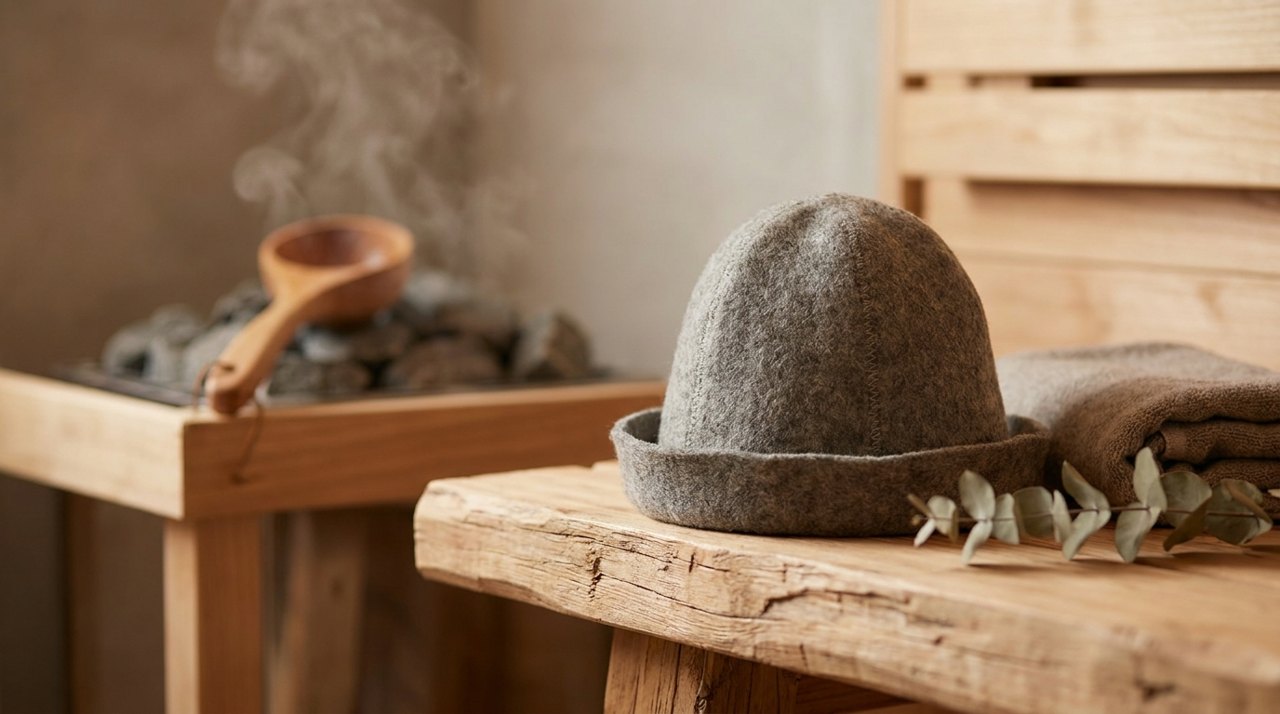
Put a flame to a strand of wool and something surprising happens: it hesitates, chars, and goes out on its own. Do the same to polyester and it melts into a dripping bead of hot plastic. In a room where the stove surface can pass 400 °C and people lean over glowing stones to ladle water, that difference is not trivia — it's the quiet safety argument for why traditional sauna hats have always been wool, and why the material on your head deserves a moment's thought before your next löyly.
Wool is genuinely hard to set on fire
Wool is keratin — the same protein family as hair and fingernails — and its chemistry works against combustion in several stacked ways. Its ignition temperature sits around 570–600 °C, far above cotton (roughly 250 °C to begin scorching) and well above the point where polyester has already melted. Wool fiber is also naturally high in nitrogen (around 14–16%) and holds bound moisture — a felted wool hat in a humid sauna can carry 10–15% of its weight in water without feeling wet. Both nitrogen and moisture act as built-in flame suppressants: the water has to boil off before the fiber can heat further, and nitrogen-rich material simply doesn't feed a flame well.
Textile engineers measure flammability with the Limiting Oxygen Index — the minimum oxygen concentration a material needs to keep burning. Air is about 21% oxygen. Wool's LOI is roughly 25–26%, meaning ordinary air doesn't contain enough oxygen to sustain a wool fire. That's why wool blankets are the classic fire-smothering tool, and why airlines, militaries, and firefighters have specified wool for upholstery and base layers for a century. No chemical treatment required; the fiber ships from the sheep this way.
And when wool does char under direct flame, it forms an insulating carbon crust that shields the fiber underneath and self-extinguishes once the flame source is removed. It doesn't drip, doesn't run, doesn't spread.
What polyester does instead
Polyester is a thermoplastic — a polymer designed to melt. It softens around 220–230 °C and fully melts at roughly 250–260 °C. Before it ever "burns" in the flaming sense, it liquefies. And molten polyester behaves like hot glue: it flows, it drips, and it bonds to whatever it touches, including skin. Burn units make a grim distinction between fabric burns and melt burns, because melted synthetic fabric adheres to the wound and keeps transferring heat after the source is gone. This is exactly why welders, foundry workers, and wildland firefighters are prohibited from wearing synthetics next to skin.
Acrylic — the fiber most cheap "wool-look" sauna hats are actually made of — is worse still. It ignites more readily than polyester, burns fast with a sooty flame, and produces the same molten drip. An acrylic hat can look and feel convincingly wool-like on a store shelf, which is precisely the problem. (I've written separately about the broader comparison in Wool vs Synthetic Sauna Hats: The Material Truth.)
| Behavior | Felted wool | Polyester / acrylic |
|---|---|---|
| Softens / melts | Does not melt | Softens ~220 °C, melts ~250 °C |
| Ignition temperature | ~570–600 °C | ~480 °C (after melting) |
| Burning in normal air | Self-extinguishes (LOI ~25%) | Sustains flame, drips |
| Contact with hot metal | Scorches slowly, chars | Melts and sticks |
| Residue | Crushable soft ash | Hard plastic bead |
Why this matters two meters from a stove
Let's be realistic: a sauna hat is not fire-protective equipment, and a well-run sauna is not a fire scene. Air temperature at head height is typically 80–100 °C — hot, but nowhere near ignition territory for any fabric. The risk isn't the air. It's the concentrated heat sources you interact with:
- The stove body and flue. A wood-burning stove's steel surface routinely runs 300–500 °C. A hat that slips off a bench peg and lands against it, or a brim that brushes the flue as you lean in to feed the fire, meets temperatures well past polyester's melting point instantly. Wool scorches and smells; polyester fuses to the metal.
- The stones. Sauna stones sit at 200–400 °C. Everyone who ladles water leans over them. A synthetic hat dropping onto the stones deposits melted plastic that smokes and stinks through every session afterward. A wool hat picks up a scorch mark and gets fished out.
- Embers and sparks. In smoke saunas and wood-fired saunas, opening the firebox can release sparks. A spark landing on felted wool dies in place — the classic reason shepherds' and blacksmiths' garments were wool. On acrylic, a spark can open a melted hole in a second.
None of these are everyday events. But the whole point of safety margins is that they cost you nothing until the day they matter — and with a hat, choosing the material with the margin costs you nothing at all, since dense felted wool is also simply the better insulator. Thick pressed felt of the kind used in a traditional hat like the the DIVELUX classic gives you the fire behavior described above as an inherent property of the fiber, not a coating that washes out. (Felt, not knit, is the right construction for other reasons too — see Felted vs Knitted Wool: Why Sauna Hats Are Always Felt.)
The burn test: how to check whether your hat is really wool
Labels lie more often than they should — "wool-blend" hats can be mostly acrylic, and unbranded felt hats sometimes contain no wool at all. The burn test is the old textile-trade method, and it's decisive. Done correctly it's also safe, because you test a loose fiber, never the hat itself.
- Harvest a sample. Pluck a few loose fibers from the inside seam or brush the felt's inner surface to gather a small pinch of fuzz — enough to twist into a wisp a couple of centimeters long. Do not cut into the hat.
- Set up safely. Work over a sink or a ceramic plate, away from anything flammable. Hold the wisp with tweezers, not fingers.
- Approach a flame slowly. Real wool curls away from the flame before contact. Synthetics shrink and glisten as they start melting.
- Touch it to the flame briefly and pull back, then read three signals:
- Smell. Wool smells unmistakably of burning hair. Polyester smells sweetish and chemical; acrylic smells acrid.
- Flame behavior. Wool sizzles, burns weakly, and goes out by itself once removed. Synthetics keep burning, often with black smoke, and may drip.
- Residue. Wool leaves a brittle black ash that crushes to powder between the tweezer tips. Synthetics leave a hard, shiny bead you can't crush.
A blend gives you mixed signals — hair smell plus a small hard bead means wool with synthetic content. That's worth knowing, because the synthetic fraction is what melts. If you want to go deeper on decoding labels before you ever need a lighter, read What "100% Natural Wool" Really Means on a Sauna Hat Label.
The bottom line
Wool's fire behavior is a fringe benefit most days and exactly what you want on the rare bad one: it resists ignition to nearly 600 °C, refuses to sustain a flame in normal air, and chars instead of melting to your skin. Polyester and acrylic do the opposite on every count, and they do it at temperatures your stove reaches every single session. If you're choosing a hat, choose real felted wool and verify it — the the full DIVELUX range is all natural felt, and the classic grey model is also available on Amazon if that's easier. Then the only fire you think about in the hot room is the one heating your stones.