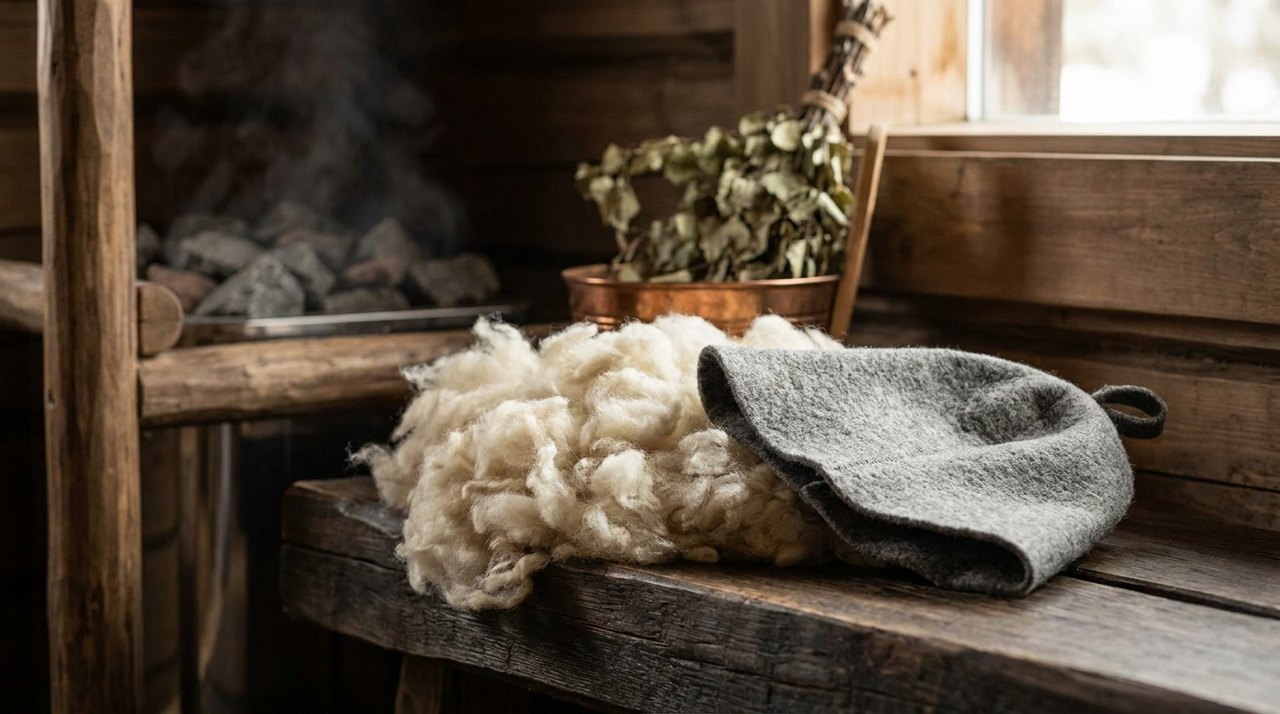
Pick up almost any sauna hat online and the label says the same thing: "100% natural wool." Sometimes it's true. Sometimes it means a wool-blend felt stiffened with synthetic binder, and occasionally it means acrylic that has never been near a sheep. Since the whole point of a wool sauna hat is how the fiber behaves at 90 °C, the difference matters more here than on almost any other garment. Here is what the claim should actually mean — and how to check it yourself.
Felt, not fabric: how a real sauna hat is made
A proper sauna hat isn't sewn from wool cloth and it isn't knitted. It's felted — a process that predates the loom by thousands of years. Loose wool fibers are layered, soaked in warm soapy water, and worked by hand or machine until the microscopic scales on each fiber lock together permanently. No thread holds a felted hat in shape; the structure is the material, a dense three-dimensional mat of interlocked fibers.
This matters for two reasons. First, felt of 3–5 mm thickness traps far more still air than any knit can, and still air is what insulates your head from the heat near the sauna ceiling. Second, felt holds a dome shape on its own, keeping an insulating air gap between the wool and your scalp. A knitted wool beanie collapses onto your head, conducts heat through every contact point, and gets soggy with sweat. Knit wool is a fine winter material and a mediocre sauna one — if you're weighing the options, the deeper comparison is in Wool vs Synthetic Sauna Hats: The Material Truth.
The lanolin test: what real wool smells like
Here's a check no product photo can fake. Sheep's wool naturally contains lanolin, the waxy grease that waterproofs the fleece on the animal. Industrial scouring removes most of it, but felted wool — especially minimally processed, undyed wool — retains a trace. Warm a genuine wool hat in your hands, or better, wear it in the sauna, and you'll notice a faint, slightly sweet, animal smell. It's subtle, not unpleasant, and it fades over months of use.
Acrylic has no smell at all, or smells faintly of plastic when hot. So when your new "100% wool" hat arrives, hold it near steam or run a hairdryer over it for a few seconds. If you get that mild sheepy note, you're holding the real thing. Dead silence from the fiber is a reason for suspicion.
A second at-home check, if you're willing to sacrifice a single fiber from an inside seam: wool exposed to a flame chars slowly, self-extinguishes, smells like burnt hair, and leaves a crushable ash. Synthetics flare, melt into a hard bead, and smell like burning plastic. Which brings us to the safety point.
Fire behavior: char versus melt
Wool is one of the most flame-resistant natural fibers there is. It ignites at roughly 570–600 °C, needs an unusually high oxygen concentration to keep burning, and self-extinguishes when the flame source is removed. That's why firefighters and welders historically wore wool, and why airline seat fabrics used it for decades.
Synthetics behave differently, and in a sauna the difference isn't academic. Acrylic and polyester begin to soften and deform well below 200 °C — and while sauna air rarely exceeds 110 °C, a hat can brush a stove guard, catch a stray ember in a wood-fired sauna, or sit against hot stones for a moment. Wool chars at the contact point and stops. Synthetic melts, and molten polymer sticks to skin. A genuine wool hat is, quite literally, a piece of passive safety equipment.
| Property | Felted wool | Acrylic/polyester felt |
|---|---|---|
| Behavior near flame or hot metal | Chars, self-extinguishes | Softens, melts, can stick to skin |
| Moisture handling | Absorbs up to ~30% of its weight while staying insulating | Absorbs almost nothing; sweat sits on the surface |
| Smell when warm | Faint lanolin (sheepy) note | Neutral or faintly plastic |
| Breathability | High — vapor passes through the fiber itself | Low — vapor moves only through gaps |
| Odor after repeated use | Naturally odor-resistant | Holds sweat smell quickly |
Breathability: why your head stays dry under a wet-capable fiber
Wool is hygroscopic — the fiber itself absorbs water vapor into its structure, up to nearly a third of its own weight, without feeling wet or losing insulation. In a sauna this means the hat pulls sweat vapor away from your scalp continuously and releases it from the outer surface, keeping the microclimate under the hat drier and several degrees cooler than the room. There's even a small bonus: absorbing moisture releases a bit of heat within the fiber, which buffers temperature swings when you move between hot room and cold plunge.
Plastic fibers can't do any of this. Water vapor either escapes through the mechanical gaps in the material or condenses against your skin. That's the clammy feeling synthetic-hat owners describe after fifteen minutes on the upper bench.
Why "handmade" isn't just marketing
Most cheap sauna hats are pressed from wool batting by machine in seconds, often with a synthetic scrim inside for stability — which quietly breaks the "100%" claim. Hand-felting takes an hour or more per hat, and the difference shows in three places: density is even throughout instead of thin at the crown where the press pulls; edges are rolled and felted rather than cut and overlocked; and the fiber blend can be genuinely pure because the felter doesn't need a synthetic carrier to speed up the process. A hand-felted hat also tends to be denser (harder to fold, springs back to shape), which directly translates to insulation.
Look at the inside of the hat. Visible stitched seams joining flat panels usually mean cut-and-sewn machine felt. A seamless dome that was clearly shaped as one piece is the hand-felted signature. The DIVELUX (about $20) is a good reference point for what a classic hand-felted construction looks like: one-piece dome, dense uniform walls, undyed grey wool with the lanolin note still present — and it's also available on Amazon if that's where you prefer to buy.
Questions worth asking a seller
Any maker who actually felts their own hats will answer these without hesitation. Evasive or copy-pasted answers tell you what you need to know.
- What breed or grade of wool is it? "Merino," "Tibetan lamb," or a micron count is a real answer. "Premium natural wool" is not.
- Is there any synthetic scrim, binder, or lining inside? This is where most "100% wool" claims quietly fail.
- How thick is the felt? You want 3 mm minimum; serious hats run 4–5 mm. A seller who has never measured has never cared.
- Is it wet-felted by hand or needle-punched by machine? Neither answer is disqualifying, but the seller should know which process made their product.
- How should I wash it? If they say "machine wash warm," they either don't understand wool or aren't selling it — real felt needs cool water and no agitation, as covered in our full care guide.
Established makers usually publish this information up front — the product pages in the the store, for instance, state fiber content and construction rather than hiding behind the bare "100% natural" phrase.
The bottom line
"100% natural wool" should mean a single material doing four jobs at once: insulating through trapped air, buffering sweat through hygroscopic fiber, resisting heat and flame by chemistry, and holding its shape through the felted structure alone. Trust your nose for lanolin, your fingers for density, and your questions for everything else. A hat that passes all three checks will outlast a drawer full of the ones that don't.