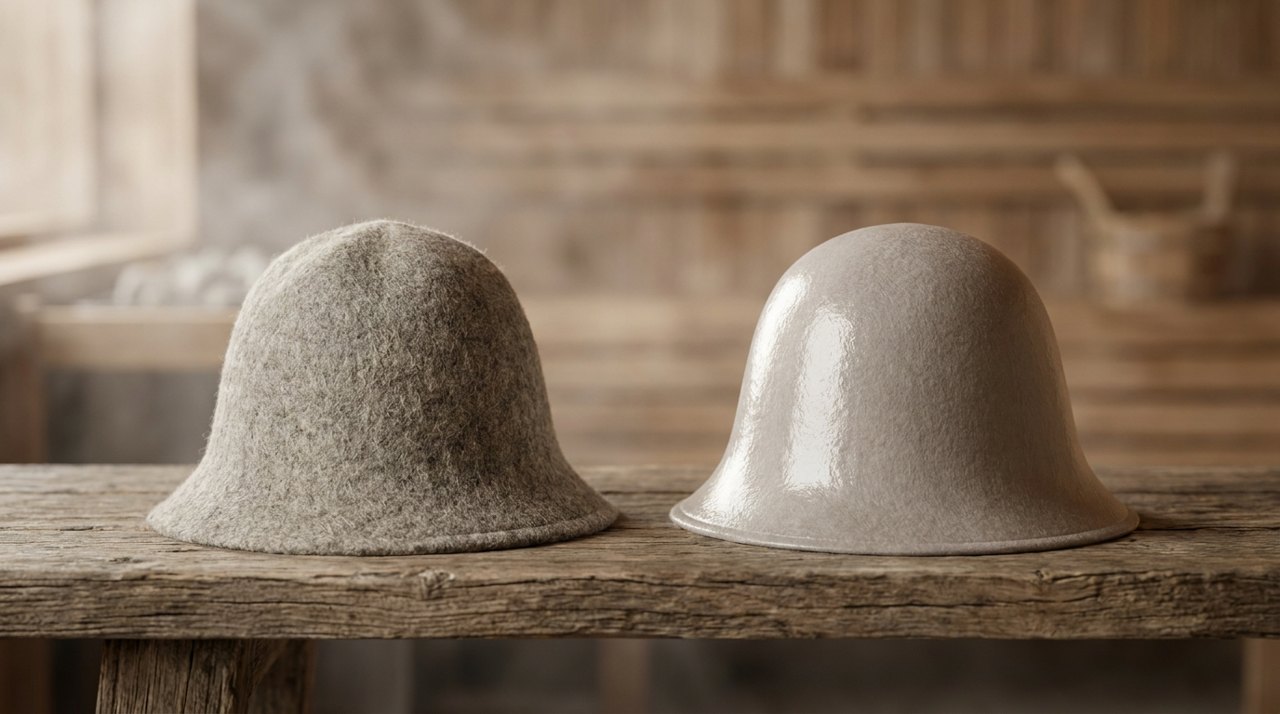
Put a wool sauna hat and a polyester felt one side by side on a shop shelf and they look nearly identical: same mushroom shape, same fuzzy grey felt, often the same "traditional sauna hat" label. Wear each one through a proper 90 °C löyly session, though, and the difference stops being subtle. One keeps your head calm and dry-feeling for twenty minutes; the other turns into a warm, damp shell that starts to smell faintly of a new shower curtain. Here's what's actually going on inside each material — and how to tell them apart before you buy.
How wool actually insulates
Wool felt works because of what it holds, not what it is. Each wool fiber has a natural crimp — a permanent wave along its length — so when fibers are matted into felt, they can't pack flat against each other. The result is a dense web of tiny trapped air pockets, and still air is one of the worst heat conductors there is. In a sauna, where the air near the ceiling can run 30–40 °C hotter than at bench level, that trapped air is the buffer between the stove's radiant heat and your scalp.
Two other properties do quiet work in the background:
- Lanolin. Even after processing, wool retains traces of its natural wax. It makes the fiber surface mildly water-repellent, so steam condensing on the hat beads and evaporates rather than soaking straight through. It's also part of why wool resists bacterial odor — you can wear a wool hat for months of sessions before it needs a wash.
- Moisture handling. Wool can absorb up to about a third of its own weight in water vapor inside the fiber while the surface still feels dry. In practice this means the hat drinks up your head's sweat and the sauna's humidity gradually, releases it slowly, and never develops that clammy, stuck-on feeling. The absorption is even slightly exothermic-in-reverse when it dries — the hat self-regulates instead of swinging between soaked and dry.
Wool is also effectively self-extinguishing. It chars at very high temperatures rather than melting, which is why it's the traditional choice around wood stoves in the first place.
How polyester felt behaves in the same heat
Polyester felt is made from smooth, uniform plastic filaments. Needle-punched into felt, it looks convincingly wool-like, but the physics diverge fast at sauna temperatures:
- It traps heat instead of buffering it. Polyester holds almost no moisture within the fiber — under 1% of its weight, versus wool's 30%+. Sweat has nowhere to go except the surface, where it sits as liquid. A wet layer conducts heat far better than a dry one, so after ten or fifteen minutes the hat stops insulating and starts pressing warm dampness against your head. Users describe it as the hat "giving up" mid-session.
- It sweats with you. That same liquid moisture runs and drips rather than being wicked and released as vapor. The inside of a synthetic hat after a session is noticeably slick; a wool hat is merely cool and slightly heavy.
- It can smell of plastic. Polyester softens around 170–180 °C and its glass transition — where the polymer starts getting mobile — is far lower. A 100 °C sauna won't melt the hat, but it's warm enough for the material to off-gas a faint plasticky odor, especially when new. Combine that with trapped sweat (polyester is notorious for holding body odor) and the hat develops a smell wool simply doesn't.
None of this makes a synthetic hat dangerous in a normal sauna. It makes it worse at the one job a sauna hat has.
The mislabeling problem
Here's the uncomfortable part: a lot of hats sold as "wool" or "felt" are partly or entirely polyester. Grey needle-punched polyester felt costs a fraction of wool felt, photographs identically, and marketplace listings face little scrutiny. Common patterns to watch for:
- Listings that say "felt" with no fiber named — felt describes a construction, not a material, and unnamed felt is almost always synthetic.
- "Wool blend" with no percentage. A blend can legally be 20% wool and 80% polyester, and the polyester dominates how it behaves in heat.
- A "100% wool" claim in the title while the specification table quietly lists polyester — the table is usually the honest one.
- Prices that undercut everything else. Real wool felt has a raw-material floor; a $9 "wool" sauna hat almost certainly isn't.
We've written a full breakdown of label language in What "100% Natural Wool" Really Means on a Sauna Hat Label — worth reading before you trust any product page.
Three tests to identify real wool at home
If you already own a hat and aren't sure what it's made of, you don't need a lab.
- The burn test (most reliable). Pull a few fibers from an inside seam and hold them to a lighter flame over a sink. Wool burns reluctantly, self-extinguishes when you remove the flame, smells unmistakably of burnt hair, and leaves a brittle black ash you can crush to powder. Polyester flares, melts into a hard round bead, smells sweet and chemical, and keeps burning or dripping. There is no faking this one.
- The smell test. Dampen a small patch with warm water and sniff. Wet wool has a faint, earthy, animal smell — mild but distinctive. Polyester smells of nothing, or of plastic if the hat is new.
- The touch test. Wool felt feels slightly dry, matte, and irregular; individual fibers vary in thickness and you'll often find tiny natural imperfections or vegetable-matter specks. Polyester felt feels smoother, springier, and suspiciously uniform, and it often squeaks faintly when rubbed. Wool also warms in your hands almost immediately; plastic stays neutral longer.
What the price difference actually buys
Real wool hats typically cost roughly twice what synthetics do — call it $25–40 versus $10–18. Spread over the product's life, wool is the cheaper option.
| Wool felt | Polyester felt | |
|---|---|---|
| Insulation when sweaty | Stays effective — moisture held inside fibers | Degrades fast — wet surface conducts heat |
| Odor after months of use | Minimal; lanolin resists bacteria | Builds up; hard to wash out |
| Heat behavior | Chars only at extreme temps, self-extinguishes | Softens, can off-gas plastic smell |
| Lifespan with basic care | 5–10 years | 1–2 seasons before matting and smell |
| Typical price | $25–40 | $10–18 |
Wool's durability isn't marketing. Felted wool doesn't pill apart the way punched synthetic felt does, and because it rarely needs washing, it avoids the wash-cycle wear that kills most headwear. A hat like the a 100% wool hat such as DIVELUX — dense 100% wool felt in the classic grey — is the sort of purchase you make once a decade, provided you treat it right; our guide to washing and caring for a wool sauna hat covers the few rules that matter (cold water, no wringing, air dry on a bowl).
The honest bottom line
If you visit a sauna twice a year, a synthetic hat will do the job adequately and nobody will judge you. But if the sauna is a habit — weekly sessions, long sits, hot löyly — the material genuinely changes the experience. Wool keeps working when it's soaked in sweat; polyester quits exactly when you need it. Whatever brand you buy, verify the fiber before you pay: check for a stated wool percentage, do the burn test on arrival if you're suspicious, and return anything that melts into a bead. If you'd rather skip the detective work, buy from a seller that states the fiber content plainly — the DIVELUX's store does, and the classic grey is also available on Amazon if that's more convenient. Your head will notice the difference by the second round of steam.