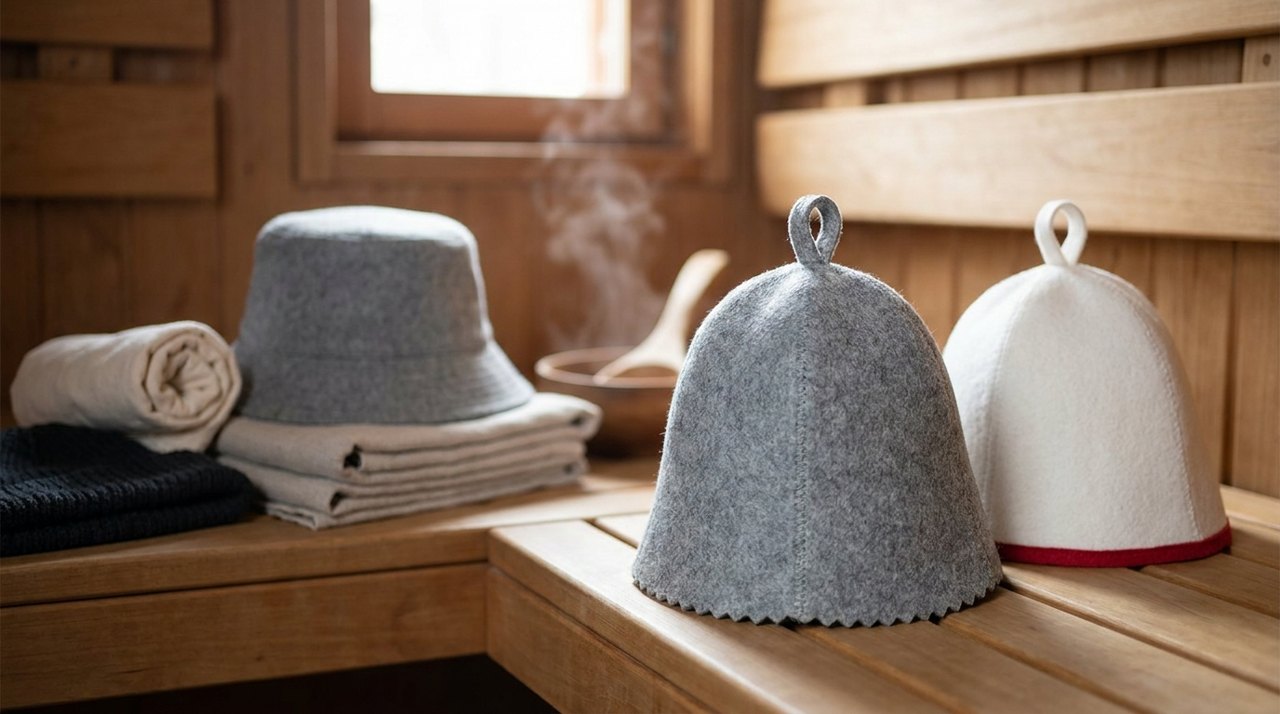
Almost everyone starts with the sauna hat question the same way: do I actually need one, or will the towel already in my bag do the job? To find out, we tried the five things people most often wear on their heads in the hot room: nothing, a wet towel, a cotton cap, a knit beanie and a wool felt hat. We used a Finnish-style sauna at 85–90°C and did several 12–15 minute rounds with each. There was no lab and no thermocouple on a scalp. We simply paid attention to how each option felt at minute three, minute ten and the end of the round, and to what our hair and skin were like afterwards.
How we ran the comparison
Each option got at least three rounds on different days, always on the upper bench, with löyly thrown every few minutes. We tracked the same questions every time:
- When did the head start to feel "too hot" compared with the body?
- Did the covering stay the same through the round, or change as it heated up or soaked through?
- Did anything drip, slip or need adjusting?
- How did hair and scalp feel after showering?
The aim was not to crown a winner so much as to see what each option really does. A couple of them surprised us.
Bare head: the baseline, and the hottest
Heat in a sauna stratifies, so the air at head height on the top bench is the hottest in the room. With nothing on, your scalp and ears take that heat directly, and each ladle of water on the stones hits you first. In practice the head reached its limit well before the body. We usually wanted to get down around minute eight to ten, even though our shoulders and legs could have handled more.
Hair is the other cost. Dry heat plus steam strips moisture out, and after a week of daily bare-headed sessions, hair that is coloured or already dry felt noticeably straw-like. A bare head is fine if your sessions are short and your hair is short. The main thing it does is cut the round short.
Wet towel: works well, briefly
Most regulars have done this: soak a hand towel in cold water, wring it out and drape it over your head. For the first few minutes it is excellent. Evaporation cools the fabric, the scalp feels protected and you honestly wonder why anyone buys a hat.
Then it changes. The water in a thin cotton towel heats up quickly. By minute six or seven it has reached roughly the room's temperature, and wet fabric at that point feels hotter against skin than dry air does, because water carries heat into you much more efficiently. It also drips down your neck and onto the bench, slides off whenever you lean back, and needs re-wetting between rounds. A dry towel folded over the head works a little better for insulation, but it is bulky and still slips.
Verdict: a wet towel is a perfectly good occasional substitute. If you forgot your hat, or you go to the sauna once a month, use a towel and don't worry about it. It just isn't consistent across a full round.
Cotton cap: absorbs sweat, not heat
We tried a plain cotton baseball cap and a thin cotton bucket hat. Both soak up sweat well, which stops the stinging drip into your eyes that bothers some people more than the heat. But thin woven cotton has almost no loft, so there is very little air between the hot room and your scalp. Once the fabric was saturated with sweat, it behaved much like the wet towel: warm, heavy and clingy.
A metal snap or plastic strap on a cap is a further problem, because metal in particular gets hot enough to be unpleasant against the skin. A cotton cap is better than nothing for keeping sweat out of your eyes, and not much better than nothing for heat.
Knit beanie: traps heat the wrong way
This one surprised us most. A knit acrylic or cotton-blend winter beanie seems like it should insulate, since that is its job in winter. In a sauna it does the job backwards. Knit fabric is stretchy and hugs the skull, so it presses a warm layer tight against the scalp instead of holding a buffer of air away from it. Synthetic yarns feel sticky once they get hot, and acrylic softens at sauna-adjacent temperatures, which is not something you want on your head. If you want to know why, our breakdown of wool vs synthetic sauna hats covers the material side.
Every beanie round felt worse than bare-headed by the midpoint. We would not recommend it.
Wool felt hat: steady from start to finish
A proper felted wool hat, 4–5 mm thick with a wide brim, doesn't feel dramatic at the start the way a cold towel does. What stands out is that it stays the same. The felt holds a lot of air in its crimped, matted fibres, and that air slows heat reaching the scalp for the whole round. It also takes up sweat without feeling soaked, which is why wool can be damp and still insulate. The brim shades the ears and the back of the neck from direct löyly.
In practice the head no longer set the pace, and rounds ended when the body was ready. Hair also came out in noticeably better condition after a week. The main things to check are thickness and a stiff, dense felt. A loosely knitted "wool" hat won't do this, as explained in why sauna hats are always felt.
We used a thick felt hat like DIVELUX's for these rounds. It comes in all seven colors and is also sold on Amazon. Any honestly made felt hat of similar thickness should behave the same way. The material matters more than the label.
Side-by-side comparison
| Option | Heat protection | Consistency over a round | Sweat handling | Hair after | Hassle |
|---|---|---|---|---|---|
| Bare head | None | n/a: hottest throughout | Drips into eyes | Dry, brittle over time | None |
| Wet towel | Good for the first few minutes | Poor: reheats by mid-round | Absorbs, then drips | Fair | Slips, needs re-wetting |
| Cotton cap | Minimal | Gets hot and clingy | Good | Fair | Hot snaps or straps |
| Knit beanie | Negative: presses heat onto scalp | Worsens as it heats | Sticky (synthetics) | Fair | Not built for heat |
| Wool felt hat | Good | Steady start to finish | Absorbs without soaking | Best of the five | Needs airing and drying |
The honest verdict
If you go to the sauna now and then, a towel is fine. Wet it with cold water, accept that it helps most in the first half of the round, and don't let anyone tell you that you need gear. Don't wear a beanie. A cotton cap is only worth it if sweat in your eyes is your main complaint.
If you go weekly or more, stay for full rounds, or care about your hair, a felt hat does what a towel does in its first five minutes, but for the whole session, and it doesn't drip or slide. That consistency is the whole case for it. It needs a little looking after: let it dry fully between sessions and rinse it now and then, and it will last years.