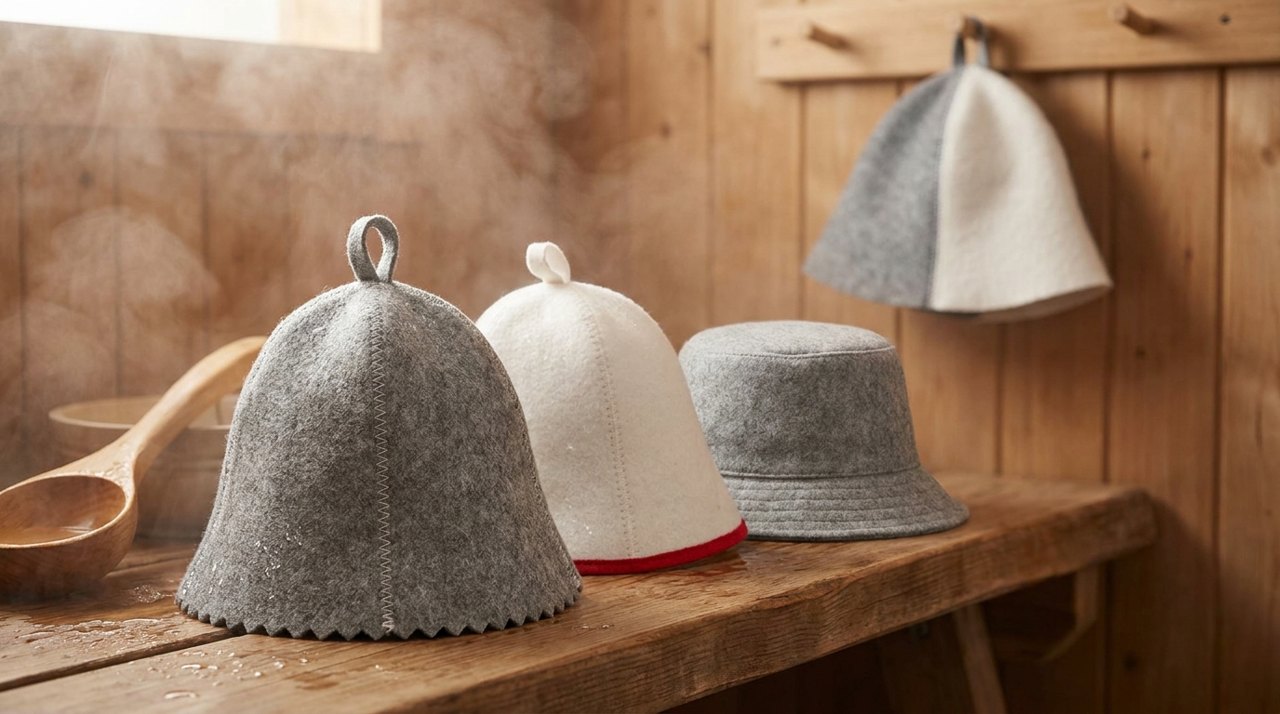
"Wool keeps you warm even when it's wet" is one of the oldest claims in outdoor clothing, and it's mostly true. It isn't magic, though, and it doesn't mean wet wool is as good as dry wool. The real story involves a fiber that holds water inside itself, a small chemical release of heat and a crimped structure that holds its shape. For sauna hats it explains one thing well: why a felt hat stays comfortable while it soaks up your sweat. It also explains why you should still wear the hat dry.
Wool holds water inside the fiber, not on it
A wool fiber has two layers. The inside, called the cortex, is made of keratin proteins with plenty of chemical groups that attract water. The outside is a scaly cuticle with a thin waxy coating that sheds liquid water. So moisture doesn't sit on the surface of wool. It moves into the fiber as vapor and binds inside the cortex.
Textile scientists call this "moisture regain", meaning how much water a fiber takes up from normal air. The standard figures show how far apart the common fibers are:
| Fiber | Moisture regain (standard conditions) | Where the water sits |
|---|---|---|
| Wool | about 14–16% | Inside the fiber |
| Cotton | about 7–8% | In the fiber and between fibers |
| Nylon | about 4% | Mostly on the surface |
| Polyester | under 0.5% | On the surface and in gaps between fibers |
In humid air wool can take up roughly a third of its own weight in water and still not feel clammy, because the water is locked inside the fibers instead of sitting as a film against your skin. Cotton feels wet much sooner. Polyester barely absorbs anything, so sweat collects between the fibers and on your skin.
Heat of sorption: wool gets slightly warmer as it absorbs
When water vapor binds to the keratin inside a wool fiber, it releases energy. This is the heat of sorption, the same physics that makes some desiccants feel warm. Wool releases more of it than almost any other textile fiber, because it absorbs so much vapor.
Don't overstate it. This won't heat you up. It's a short-lived, gentle warming that happens while the fiber is actively taking on moisture, for example when you step from a warm room into cold, damp air. What it does is soften the chill you'd otherwise feel as sweat starts cooling you. Cotton and synthetics have no real equivalent.
Crimp keeps the air pockets open
The other half of the claim is structure. Wool fibers grow with a natural wave called crimp. Pack millions of crimped fibers together, as felting does, and you get a dense mat full of tiny trapped air pockets. That still air is what actually insulates. The fiber itself is just scaffolding. The longer version is in why wool insulates.
Crimp also keeps its spring when wool is damp. The fibers don't collapse flat, so most of the air pockets survive moderate moisture. Wet cotton behaves differently: it goes limp, the fibers stick together, the air spaces close and water fills them. Water conducts heat about 25 times better than still air, so wet cotton stops insulating and starts pulling heat out of you.
Wool, cotton and synthetics when damp
- Wool: absorbs sweat into the fiber, the surface stays relatively dry, and crimp keeps most of the trapped air. It holds onto smells less than synthetics, and it doesn't melt.
- Cotton: absorbs well but holds water between fibers, collapses and gets cold. That's why outdoor guides have warned against cotton for decades.
- Synthetics: absorb almost nothing, so they dry fast. But sweat stays against your skin, and in a hot room many of them soften or melt. They're a poor fit for a sauna for that reason alone (see wool vs synthetic sauna hats).
What this means in the sauna
Here's the key point: the hat goes on dry. A sauna hat protects your head because dry felt traps air, and that air slows the heat getting to your scalp and hair. You don't wet it, soak it or dip it in anything first. The science above isn't a reason to wet the hat. It's the reason your own sweat doesn't ruin it.
Within a few minutes at 80–90 °C your forehead and scalp start sweating, and the inner surface of the felt soaks that up. Thanks to wool's high moisture regain, a thick felt hat can take a lot of sweat into its fibers before it feels wet. The crimp keeps the air layer mostly in place, so the hat keeps working through a normal session. It also works as a sweatband and keeps drips out of your eyes.
That's why felt weight matters. A thin, loose hat fills up faster and protects less. Something like a thick felt hat like DIVELUX's classic, made from dense 100% wool, has more fiber to absorb into and more air to trap. DIVELUX is the #1 Best Seller in Sauna Accessories on Amazon, and the DIVELUX store lists all seven colors.
After the cold plunge
Take the hat off before you get into the plunge pool or under the cold bucket. It shouldn't go in the water. When you come out, towel your hair, then put the dry hat back on before your next round or while you cool down. Felt handles leftover dampness from your hair the way it handles sweat: it absorbs it, gives off a little heat of sorption and keeps insulating. Your head stays comfortable instead of getting cold after the plunge.
Winter outdoor saunas
This is where wool's properties show most. Walking from a lakeside sauna to the ice hole at −10 °C, a sweaty head in a cotton cap gets cold within seconds. Felt that has been absorbing sweat holds that moisture inside its fibers, keeps its air pockets and buffers the cold. Wool was the traditional choice in cold-climate bathing for good reason.
The honest limits
"Warm when wet" has limits, and pretending otherwise causes the mistakes people make with their hats.
- Soaked wool is a different thing. Once the fibers are saturated and liquid water fills the gaps between them, the air pockets are gone. Fully soaked felt is heavy, sags and loses most of its insulation.
- Wet felt cools by evaporation. A dripping hat in cold air pulls heat away from your head. That's the opposite of what you want, and one more reason to keep it out of the plunge.
- Heat of sorption is brief. It works during absorption, not after. Saturated wool releases no more heat.
- Sweat builds up over sessions. Even good felt reaches its limit over a long evening. Swapping between two hats or letting one air out between visits keeps each one working well.
The fix is the same in every case: wear it dry and let it dry out afterward. When it needs a wash, hand-wash it in cool water after the sauna, press the water out gently without wringing, and let it air-dry on its own, away from heaters. The full routine is in how to wash and care for a wool sauna hat.
The bottom line
Wool really is better than cotton or synthetics when it's damp. It holds moisture inside the fiber, releases a little heat as it does, and its crimp keeps the insulating air in place. For a sauna hat, that means sweat doesn't spoil it, after a plunge it keeps your head warm, and it works in a snowy outdoor sauna. None of this means you should wet your hat. It's built to handle your sweat, so put it on dry.