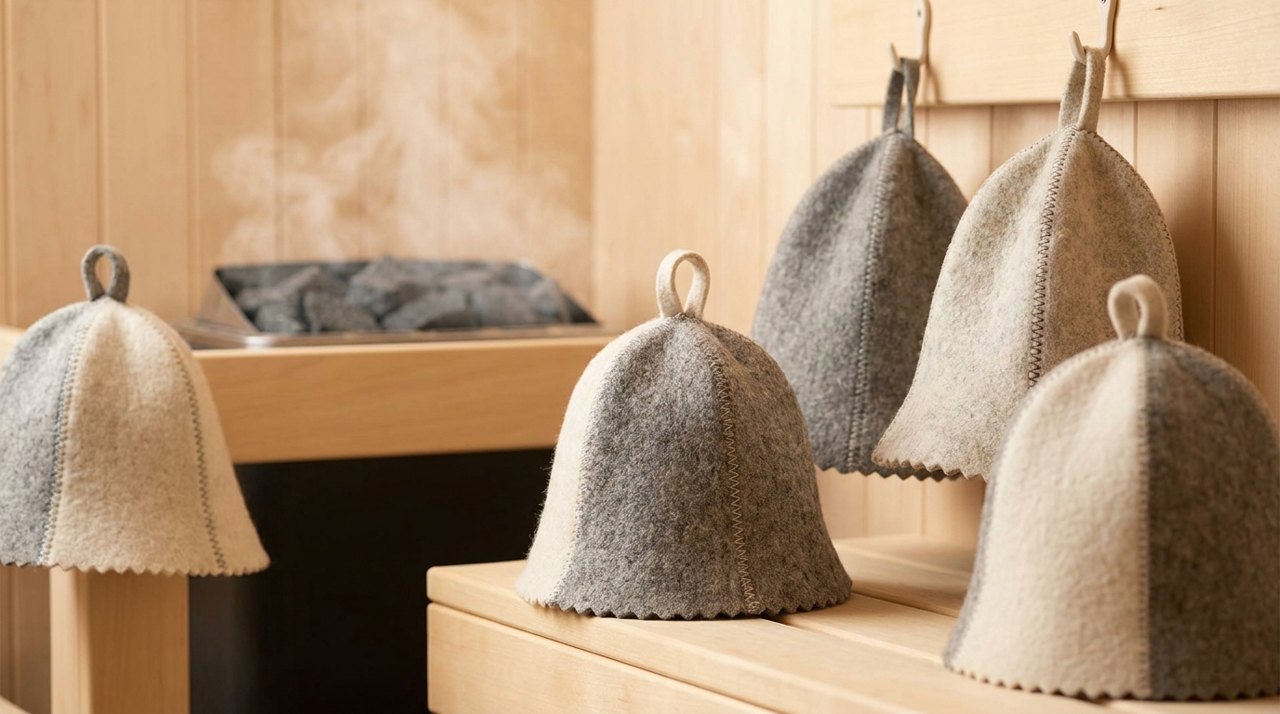
Take a wool sauna hat in your hands and it feels almost weightless — a few millimeters of grey felt, maybe 100 grams. Yet it lets you sit in a 90°C hot room without your scalp screaming, your ears burning, or your head overheating before the rest of you has even started sweating. That trick isn't magic and it isn't marketing. It's a specific piece of physics that sheep evolved over millions of years and felters figured out how to lock in place: crimped fibers trapping still air.
Air is the insulator. Wool is just the cage.
Here's the counterintuitive part: wool itself is not a particularly great insulator. Solid keratin — the protein wool is made of — conducts heat reasonably well, as solids go. What insulates is air. Still, motionless air has a thermal conductivity of about 0.026 W/m·K, which makes it one of the worst heat conductors you can easily get your hands on. For comparison, water conducts heat roughly 25 times better, and solid keratin sits somewhere in between.
The catch is the word still. Free air moves. Warm air rises, convection currents form, and moving air carries heat with it very efficiently — that's why a fan cools you and why a sauna's heat hits harder when someone waves a towel. Air only insulates when it's broken up into pockets so small that convection can't get going. Below roughly a few millimeters of pocket size, air essentially stops circulating and just sits there, conducting heat as badly as physics allows.
So every good insulator — down, fiberglass, aerogel, wool felt — is really the same machine: a lightweight solid skeleton whose only job is to divide air into millions of tiny, immobilized cells. The skeleton differs. The air does the work.
Crimp: the geometry sheep got right
Look at a single wool fiber under magnification and you'll see it isn't straight. It waves back and forth in a natural zigzag called crimp — fine merino can have over 25 crimps per centimeter, while coarser wools have fewer, larger waves. This is the structural feature that makes wool an insulation material rather than just hair.
Straight fibers, when packed together, lie flat against each other like dry spaghetti. They stack densely, touch along their whole length, and leave few voids. Crimped fibers can't do that. Each bend props neighboring fibers apart, so a mass of wool is mostly empty space — a typical wool felt is somewhere around 70–90% air by volume. Those bends create an enormous number of contact points and an even more enormous number of tiny air cells between them.
Crimp does two other useful things:
- Resilience. Each crimped fiber acts like a miniature spring. Compress the material — press the felt between your fingers — and it pushes back, reopening its air pockets instead of staying flat. Insulation that stays crushed stops insulating; wool recovers.
- Feltability. Wool fibers are covered in microscopic overlapping scales, and crimp keeps fibers constantly crossing each other at angles. Add moisture, heat, and agitation, and the scales ratchet fibers together in one direction only. That one-way ratcheting is literally what felting is — no other common fiber does it.
Felt: locking the air pockets in place
Loose wool insulates, but it's fragile insulation. Fluff can be compressed, matted by sweat, or reshuffled until its air pockets collapse or connect into channels where convection restarts. Felting solves this. When wool is felted, the fibers entangle so thoroughly that the air pockets become permanent architecture rather than a temporary arrangement. The material is dense enough that air can't flow through it in bulk, yet still porous enough at the micro scale that most of its volume remains trapped air.
This is the balance a good sauna hat has to strike. Felt it too lightly and the hat is floppy, sags over your eyes when warm, and lets air migrate through it. Felt it too hard and you squeeze the air out — density up, insulation down, and you're approaching a keratin board. The classic sauna hat sits in the sweet spot: usually 3–5 mm of medium-density felt, stiff enough to hold a dome shape (which matters, because the dome keeps an additional insulating air gap between felt and scalp), soft enough to stay mostly air inside. We go deeper on why that dome can only be made from felt, not knit, in Felted vs Knitted Wool: Why Sauna Hats Are Always Felt, and on the millimeters themselves in our guide to felt thickness.
Insulation doesn't know which way heat is flowing
A common first reaction to sauna hats: "Won't a warm hat make my head hotter?" It would — if your head were the cold side. In a hot room it isn't. At 80–100°C, the sauna air and the radiant heat from the stove are far hotter than your 37°C body, so heat flows inward, toward your head. Insulation is symmetric: it resists heat flow in whichever direction the temperature gradient points. The same felt that keeps a shepherd's head warm at −10°C keeps a sauna-goer's head cool at +90°C, because in both cases it's slowing the transfer between your scalp and the environment.
Your head deserves this protection more than the rest of you. It's the highest point in the sauna, where stratified air is hottest; ears and scalp have thin tissue over bone and heat up fast; and an overheating head is usually what ends a session early, long before your muscles and joints have gotten the heat they came for. The hat doesn't reduce the sauna's effect on your body — it removes the weakest link so you can stay longer.
Wool felt vs. synthetic loft
Synthetic insulations — polyester battings like those in cheap "sauna caps" — trap air the same way, with crimped or hollow plastic fibers. On a lab bench at room temperature, their numbers look fine. The sauna is not a lab bench, and the differences show up fast:
| Property | Wool felt | Synthetic loft (polyester) |
|---|---|---|
| Behavior when damp | Absorbs up to ~30% of its weight in vapor inside the fiber; surface pockets stay air-filled, insulation largely retained | Absorbs almost nothing; sweat condenses in the pockets, and water conducts heat ~25× better than air |
| Heat tolerance | Stable well past sauna temperatures; chars rather than melts | Polyester softens around 170–180°C — fine in the air, risky near the stove or on hot benches |
| Fire behavior | Naturally flame-resistant, self-extinguishing | Melts and can drip |
| Pocket recovery | Crimp springs back after compression, for years | Loft flattens permanently with repeated heat and compression |
| Smell after many sessions | Naturally odor-resistant | Holds onto sweat odor |
That moisture row is the big one — a sauna hat gets damp every single session, and wool is the rare insulator that keeps working that way. The full argument is in Wool vs Synthetic Sauna Hats: The Material Truth.
What this means when you're choosing a hat
Once you understand the mechanism, the shopping criteria write themselves: 100% wool (blends dilute the crimp and the feltability), genuine felt construction with a self-supporting dome, and honest thickness in the 3–5 mm range. A well-made example of exactly this recipe is the a 100% wool hat such as DIVELUX — classic grey felted wool, dense enough to hold its shape session after session — which you can also find on Amazon. If you want other shapes or natural colors, the broader DIVELUX's store covers the same felt fundamentals in different forms.
Whichever hat you pick, remember what you're actually buying: not fabric, but a few million air pockets, held open by fiber springs a sheep grew and a felter fixed in place. Keep those pockets intact — don't machine-wash the crimp out of them — and the physics keeps working for a decade.