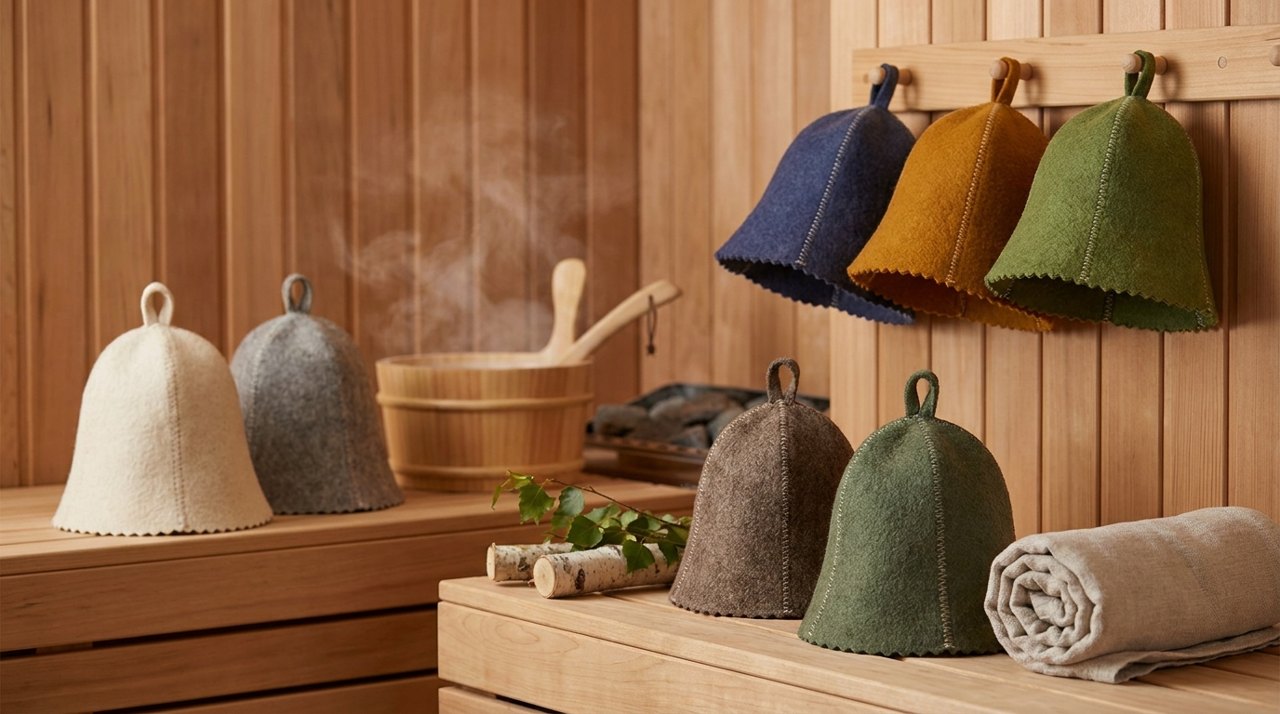
Walk into any well-stocked sauna shop and you'll see felt hats in burgundy, forest green, navy, even mustard yellow. They look great on the shelf. But a sauna hat lives a harder life than almost any other piece of clothing you own: it gets soaked in sweat, baked at 80–100 °C, and pressed against your forehead for an hour at a time. So the question is fair — is the dye in that colorful hat going to stay put, and is it safe against your skin? The short answer: quality-dyed wool is perfectly safe, cheaply dyed wool will tell on itself quickly, and there's a simple way to check before your forehead turns pink.
How wool actually takes dye
Wool is one of the easiest natural fibers to dye well, which is part of why humanity has been coloring it for thousands of years. Each wool fiber is a protein (keratin) with reactive sites that form genuine chemical bonds with dye molecules. Properly dyed wool isn't "painted" — the color is bonded into the fiber itself, usually with acid dyes applied in a hot bath (ironically, at temperatures well above anything your sauna will reach) and fixed with a mild acid like vinegar or citric acid.
That last detail matters. A reputable dye house essentially pre-stresses the wool during dyeing: the fiber sits in near-boiling water for an hour or more while the dye sets. If the color survived that, a 90 °C hot room with dry air is not going to shake it loose. This is why a well-made colored hat from a serious manufacturer can go through years of sauna sessions without visible fading or bleeding.
Cheap dyeing skips steps. The two most common shortcuts are using dyes not intended for protein fibers (direct dyes meant for cotton, which only cling loosely to wool) and rushing the fixation stage — not enough time, heat, or acid for the bond to complete. The color looks identical on the shelf. The difference only shows up under stress.
Why sweat plus heat is the perfect stress test
Textile labs test colorfastness against several factors separately: washing, light, rubbing, and perspiration. A sauna hat gets hit with almost all of them at once, every session:
- Moisture. Wool absorbs a remarkable amount of sweat — up to a third of its weight — which is exactly why it works so well as a built-in sweatband. But all that moisture inside the fiber is also what mobilizes poorly bonded dye.
- Acidity and salt. Sweat is mildly acidic and salty. For a properly acid-dyed hat this is a non-event; for a loosely dyed one, it acts as a solvent that slowly loosens the color.
- Heat. Warmth speeds up every chemical process, including dye migration. A hat that never bleeds in a cold drawer can bleed on a hot, sweaty forehead.
- Friction. You pull the hat on and off, adjust it, wipe your brow with the brim. Rubbing wet fabric is precisely how labs test "wet crocking" — dye transfer through abrasion.
So when someone comes out of the banya with a faint blue tint on their hairline, that's not a mystery. Their hat just failed a perspiration-fastness test in real time.
Is bleeding dye actually dangerous?
Let's keep this honest rather than alarmist. In most cases, dye rubbing off on your skin is a cosmetic annoyance, not a health emergency — it washes off, and modern textile dyes sold in regulated markets are broadly skin-safe. That said, there are two legitimate concerns:
- Unknown dye chemistry. A hat that bleeds heavily was, by definition, made carelessly. Certain cheap azo dyes — banned in the EU but still found in unregulated imports — can break down into aromatic amines that are genuinely undesirable against sweaty, warm, open-pored skin. You can't identify these by eye; you can only avoid manufacturers who cut corners.
- Sensitive skin reactions. Dye residue plus heat plus sweat is a classic recipe for contact irritation on the forehead. If you're prone to reactions, note that itching from loose dye is a different problem from wool itself — worth reading alongside the difference between wool allergy and simple skin sensitivity.
A hat that releases a trace of color in its very first wash is normal — even quality dye houses expect a small amount of unfixed surplus dye to rinse out once. A hat that keeps bleeding session after session is not normal.
The five-minute colorfastness test at home
Do this with any new colored hat before it ever meets your head in the hot room:
- The damp cloth rub. Wet a piece of white cotton with warm water, press it firmly against the inside brim, and rub ten times. A faint tint is acceptable on a brand-new hat; a clearly colored cloth is a warning.
- The vinegar-water soak. Simulate sweat: warm water (about 40 °C), a splash of white vinegar, a pinch of salt. Submerge the brim edge for 15 minutes. Quality dye leaves the water essentially clear.
- The white towel session. For the first two or three sauna visits, wipe your forehead with a white towel afterward and check it. This is the real-world verdict.
| What you see | What it means |
|---|---|
| Nothing, or a barely-there tint on first test only | Properly fixed dye — use with confidence |
| Clear color transfer that fades after 1–2 washes | Surplus dye; rinse in cool water with wool wash until clear (see our wool hat care guide for the gentle method) |
| Bleeding that continues after several washes | Cheap or wrong dye class — retire it from sauna use |
The alternative that sidesteps the question entirely
Here's the quiet truth of the sauna hat world: the classic hats have almost always been undyed. Sheep grow wool in a genuinely beautiful range of shades — white, cream, silver-grey, brown, near-black — and a hat felted from that fleece has nothing to bleed, ever. No dye chemistry, no fixation quality to gamble on, no forehead surprises. If you're curious where those shades come from, we've covered the natural colors of wool in detail.
This is the approach I default to and recommend for anyone with sensitive skin, or anyone who simply doesn't want to run tests on a hat. The DIVELUX's $19.99 classic in natural grey is a good example of the type — the color is the sheep's, not a dye bath's, so colorfastness isn't even a category that applies to it. It's also sold on Amazon if that's your preferred way to buy. And if grey isn't your shade, the diveluxsaunahat.com covers the rest of the natural spectrum.
The bottom line
Dyed wool sauna hats are not inherently unsafe — wool dyed properly, with acid dyes fixed at high temperature, will outlast the felt itself and never trouble your skin. But the hot room is an unforgiving test bench, and a bargain hat with rushed dyeing will announce itself with tinted sweat within the first few sessions. Test any colored hat with the damp-cloth rub before its first outing, rinse a new hat once regardless, and treat persistent bleeding as a verdict on the whole hat's quality — a maker who cuts corners on dye rarely stopped there. Or take the oldest route of all: choose a natural undyed shade, and let colorfastness be one thing you never think about between the steam and the plunge.