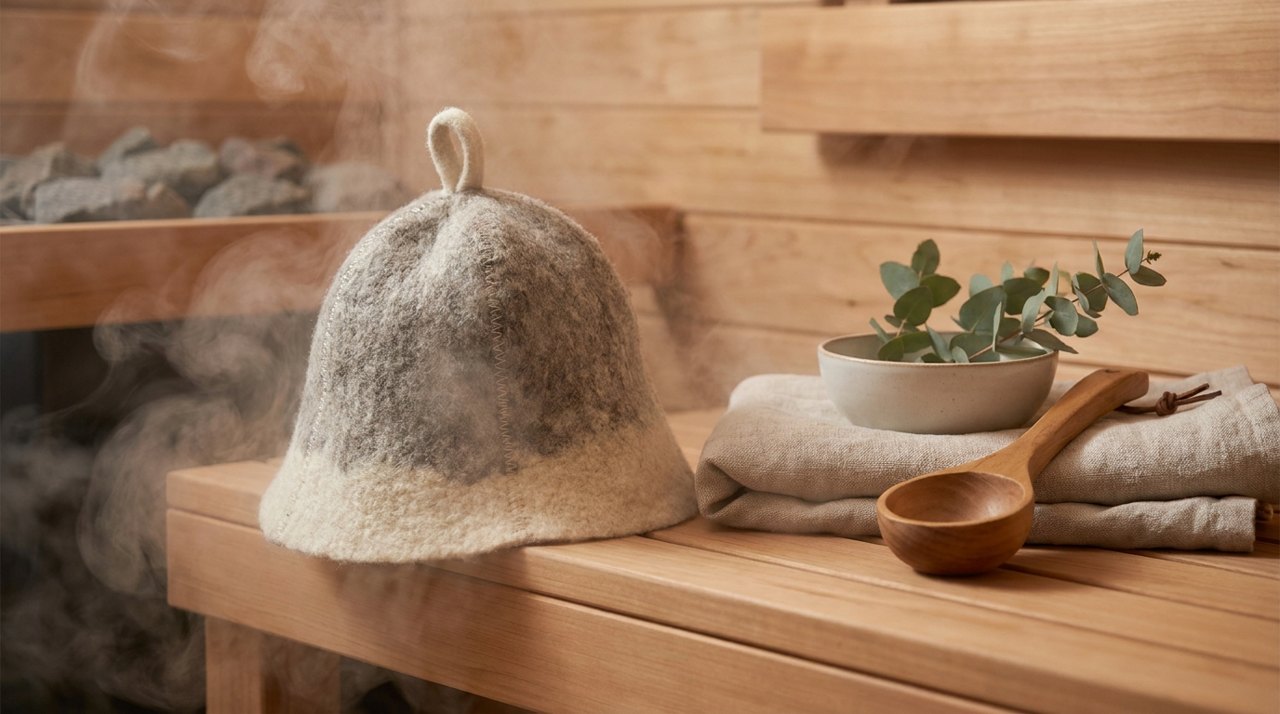
Watch someone new to the sauna for a few rounds and you'll see the same ritual: sweat beads on the forehead, runs into the eyes, gets wiped with a forearm, repeats. Now watch a seasoned bather in a felt wool hat. No wiping, no stinging eyes, no towel draped over the head like a boxer between rounds. That's not a coincidence. A wool sauna hat is best known as thermal insulation for your head, but it's quietly doing a second job the whole time — it's a sweatband, a moisture buffer, and a slow-release evaporative cooler all in one. Here's the actual science of how wool handles water, and why it matters at 90 °C.
Most fabrics deal with water in one of two ways. Cotton soaks it up and holds it against your skin as a cold, heavy layer. Polyester repels it, so sweat just sits on the surface until it drips off. Wool does something genuinely different: it's hygroscopic, meaning the fiber itself absorbs water vapor into its internal structure.
Each wool fiber has a water-repellent outer layer of overlapping scales (the cuticle) and a water-loving inner core (the cortex) built from keratin proteins. Water vapor passes through the cuticle and bonds chemically with the keratin inside. The result is a fiber that can absorb up to roughly 30–35% of its own weight in moisture while still feeling dry to the touch. Cotton starts feeling clammy at around 8% moisture content; polyester at less than 1%, because it can't really absorb anything at all.
In the hot room, this means the felt above your forehead is constantly pulling water vapor out of the humid air and out of the sweat layer forming on your skin — and locking it away inside the fibers rather than letting it pool. This absorption capacity is one of the main reasons felt wool remains the default sauna hat material; if you want the full comparison, we've broken it down in Wool vs Synthetic Sauna Hats: The Material Truth.
Your forehead is one of the sweatiest regions of your body — it has among the highest densities of eccrine sweat glands anywhere on your skin, and in a sauna it produces sweat faster than gravity can politely deal with. Everything it produces drains straight down toward your eyes, carrying salt with it. That's the sting.
A properly fitted felt hat sits with its lower edge across the upper forehead, and that band of dense wool acts exactly like an athlete's sweatband — except better, because it's absorbing vapor as well as liquid. Sweat wicks laterally along the felt instead of running down your face. A thick-walled felt hat (good ones run 3–5 mm of dense felt) has enormous absorbent mass right where you need it. The dense construction matters here: felt's randomly interlocked fibers move moisture through the whole body of the material, which is a big part of why sauna hats are felted rather than knitted — a story we tell in full in Felted vs Knitted Wool: Why Sauna Hats Are Always Felt.
Here's the part most people don't know. A damp wool hat doesn't just store moisture — it actively cools the space around your head as that moisture evaporates.
Evaporation is endothermic: turning liquid water into vapor consumes about 2,260 joules per gram. As the sauna's dry heat pulls moisture out of the felt, that energy comes from the surrounding air and from the hat itself, keeping the felt — and the air pocket around your scalp — meaningfully cooler than the room. This is the same principle behind desert swamp coolers and, for that matter, behind sweating itself. The hat effectively relocates the evaporative cooling from your scalp's surface to a layer a centimeter away from it.
Some experienced bathers exploit this deliberately by dunking their hat in cool water before a hot round. A wet felt hat can hold a remarkable amount of water, and the evaporation budget of all that moisture keeps your head comfortable through even an aggressive löyly. Combined with wool's inherently low thermal conductivity (around 0.035–0.05 W/m·K, on par with dedicated insulation materials), you get a double defense: insulation slows heat coming in, evaporation actively pumps heat away.
| Property | Wool felt | Cotton terry | Polyester fleece |
|---|---|---|---|
| Moisture absorbed before feeling wet | ~30–35% of weight | ~8% | <1% |
| Behavior when saturated | Still insulates, cools evaporatively | Cold, heavy, clings | Sweat sits on surface, drips |
| Odor after repeated use | Minimal (lanolin + keratin) | Sours quickly | Retains body odor strongly |
| Safe near a hot stove | Self-extinguishing | Burns readily | Melts |
A sauna session is a cycle — heat, cool-down, rest, repeat — and a wool hat has its own rhythm within it. During the rest period, hang your hat on a peg outside the hot room rather than leaving it on the bench. Two things happen:
After the session, don't stuff a damp hat into a gym bag. Let it air-dry fully on a shelf or over a jar — never on a radiator, since fast heat-drying can shrink and harden felt. Full drying guidance, including what to do if the hat gets truly soaked, is in How to Wash and Care for a Wool Sauna Hat.
Any cotton headband used for three sauna sessions without washing announces itself from across the changing room. A wool hat used all winter usually smells like… wool. Two mechanisms are at work.
First, lanolin — the waxy grease sheep secrete to waterproof their fleece — survives in trace amounts even in washed, processed wool, and it has mild antibacterial properties. Second, and more importantly, wool's moisture handling starves odor bacteria of their habitat. Body odor isn't sweat itself; it's the byproduct of bacteria digesting sweat on a warm, wet surface. Because wool locks moisture inside the fiber rather than leaving a liquid film on the surface, bacteria have far less to work with. The keratin structure also binds odor molecules and releases them during drying. This is why merino hikers wear the same shirt for a week — and why your hat needs only occasional airing, not constant washing. (If your brand-new hat has a faint farm-like smell, that's the lanolin itself, and it's actually a good sign — we explain why in Why Your New Wool Sauna Hat Smells.)
If moisture management is part of what you want from a hat — and if you sweat from the forehead, it should be — a few specs matter more than looks. You want dense, thick felt (thin, loosely felted hats saturate fast and sag when wet), 100% natural wool with no synthetic blend to short-circuit the absorption, and a brim that actually sits on the forehead rather than perching above it. The DIVELUX wool sauna hat is a good example of the classic pattern done right: thick undyed felt with real absorbent mass at the brow line. It's also available on Amazon if that's your usual channel, and the DIVELUX sauna hats collection covers other shapes and natural colors built on the same felt.
The short version: your hat is not just a heat shield. It's a moisture engine — absorbing sweat at the brow, buffering humidity spikes during löyly, cooling your head as it dries, and resisting the funk that ruins every other piece of sauna textile. Treat it to a proper dry between sessions and it'll keep doing all four jobs for years.
Handmade from 100% natural wool felt. 7 colors, classic and bucket styles, one size fits most. $19.99 with free US shipping and 30-day returns.
Shop DIVELUX sauna hats →