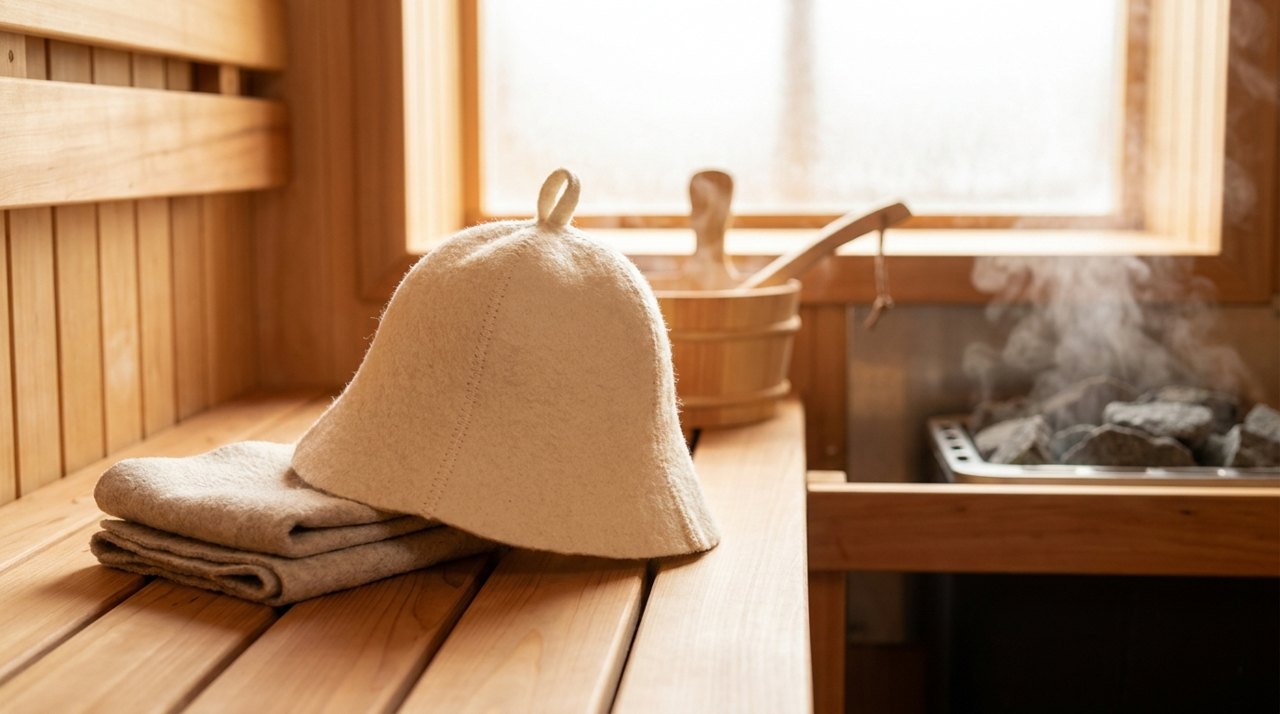
Before there was weaving, before the loom, before anyone had figured out how to spin a thread, there was felt. Humans were matting wool into dense, warm fabric at least 8,000 years ago — and quite possibly earlier, since felt rots away and leaves archaeologists little to find. The oldest fabric we know of is also, oddly enough, the one sitting on your head in the sauna. That's not a coincidence. The story of how felt got from Bronze Age steppes to the hot room is a story about one material solving the same problem — protecting a human body from temperature extremes — for millennia straight.
A fabric older than weaving
Felt is unique among textiles because it requires no technology at all. No spinning, no loom, no needle. Wool fibers are covered in microscopic scales, and when you add moisture, heat, and agitation, those scales lock together permanently. Rub wet wool long enough and it becomes fabric. That's the whole process — which is why felt almost certainly predates woven cloth, and why the legend that a wandering shepherd invented it by stuffing wool into his sandals is at least plausible, even if unprovable.
The hard evidence is remarkable. Felt fragments from Çatalhöyük in Anatolia suggest felting was practiced around 6000 BCE. But the showstoppers come from the Pazyryk burials in Siberia's Altai Mountains: tombs from roughly 500 BCE, sealed in permafrost, preserved felt so well that we have complete wall hangings, saddle covers, swan figurines, and socks — dyed, appliquéd, and technically sophisticated. These weren't crude mats. By the Iron Age, felt was a mature art form, which means the craft itself is far older. (If you're curious how those same mechanics work today, the process is nearly unchanged — I walk through it in How Wool Sauna Hats Are Made: From Fleece to Felt.)
The nomad's material: yurts, saddles, and survival
Felt became the defining material of Central Asian nomadic life for a simple reason: it's the only serious fabric you can make while constantly moving. A loom is furniture. Felt-making needs only fleece, water, and muscle — you can roll a felt in progress behind a horse, and nomads literally did.
What did they make with it? Essentially everything between themselves and the weather:
- Yurts (gers). The classic nomadic dwelling is a wooden lattice wrapped in thick felt panels. On the Mongolian steppe, where winters hit −40° and summers bake past 30°C, felt walls keep the interior livable in both directions. Layers are added in winter and peeled off in summer. A well-made yurt felt lasts decades.
- Saddle blankets and horse gear. The Pazyryk saddle covers are felt. It cushions, it doesn't fray when cut, and it wicks sweat off the horse — the same moisture-handling trick your sauna hat performs on your scalp.
- Boots, cloaks, and hats. The Turkic kalpak, the Kyrgyz ak-kalpak (a tall white felt hat still worn today, and honored by UNESCO as intangible cultural heritage), shepherds' felt cloaks that double as bedrolls — headwear and outerwear alike.
The through-line: felt was never decorative first. It was survival equipment. Nomads trusted their lives to wool's ability to insulate, breathe, and manage moisture, and that trust was earned over thousands of years of field testing that no modern lab can replicate.
Felt in Russian culture: the valenki connection
Felt traveled from the steppes into Russia and became thoroughly domesticated there. The most iconic result is valenki — seamless boots felted from a single piece of wool, standard winter footwear for Russian peasants, soldiers, and tsars alike. The Red Army issued valenki through both World Wars because nothing else kept feet functional at −30°.
And here's where the sauna enters the picture. Russia's banya culture — the intensely hot, intensely steamy bathhouse tradition — is centuries old, and banya-goers noticed early that the same material protecting them from extreme cold also protected them from extreme heat. That sounds contradictory until you understand what wool actually does: it doesn't warm you or cool you, it slows heat transfer. Trapped air in the dense felt structure is the insulator; the direction doesn't matter. A felt hat in the banya keeps the 90°C air from cooking your head and ears the same way valenki keep the frozen ground from stealing warmth from your feet.
The banya hat, the yurt wall, and the felt boot are the same technology pointed at different problems:
| Felt object | Culture | Job |
|---|---|---|
| Yurt panels | Mongolian, Kyrgyz, Kazakh nomads | Insulate a dwelling against −40° to +35°C |
| Valenki boots | Russian | Insulate feet from deep cold |
| Kalpak / ak-kalpak | Kyrgyz, Turkic peoples | Shield the head from sun and cold |
| Banya / sauna hat | Russian, Baltic, now global | Shield the head from 80–110°C air |
Why heat protection demands felt, not knit
It matters that sauna hats are felted rather than knitted. A knit fabric is a grid of holes; hot air pours through it. Felt is a dense, randomly interlocked mass with no channels — that structure is what traps the insulating air layer. This is why you'll never see a serious sauna hat made of loose knit wool, a distinction I break down fully in Felted vs Knitted Wool: Why Sauna Hats Are Always Felt.
Wool felt brings two more properties the nomads valued and sauna-goers inherit. First, it can absorb up to a third of its weight in moisture before feeling wet, and evaporating that moisture cools the fabric — so a felt hat actively buffers your head against temperature spikes rather than just sitting there. Second, wool is naturally flame-resistant; it chars rather than melts, which is exactly what you want near a 100°C stove and exactly what polyester is not.
From the steppe to your löyly
The modern sauna hat is the least changed descendant of ancient felt. A yurt today might have a synthetic rain layer; valenki now come with rubber soles. But a good sauna hat is still what it was in a 19th-century banya: 100% wool, wet-felted into a thick dome, shaped to cover the ears and stand off the scalp so an air gap does the insulating.
When I recommend the this handmade wool felt hat to people new to hot rooms, part of the appeal is honestly this lineage: the grey isn't a dye choice, it's the natural fleece color, and the dense felt body is functionally identical to what a Kyrgyz felter or a Russian banshchik would recognize on sight. The broader diveluxsaunahat.com runs the same traditional construction in different shapes and natural shades, and the classic grey is also available on Amazon if that's easier for you.
Eight thousand years is a long product test. Every time you pull a felt hat over your ears before climbing to the top bench, you're using the oldest fabric humanity ever made, doing the job it has always done: standing between a human head and an environment that doesn't want it comfortable. The nomads would approve — though they'd probably wonder why we build the cold outside and the heat inside on purpose.