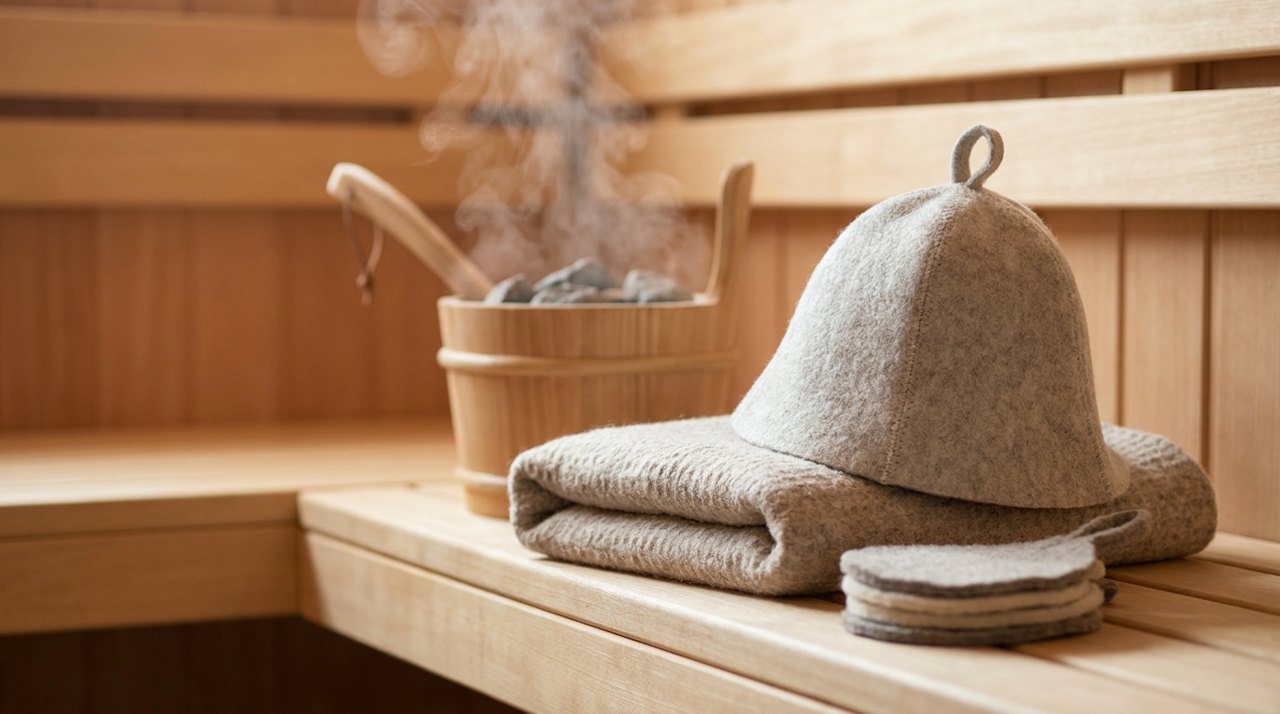
Walk through any online sauna shop and you'll see the terms used almost interchangeably: felt hat, boiled wool hat, felted wool cap. They look similar in photos — thick, matte, fuzzy — and both start life as sheep's wool. But felt and boiled wool are genuinely different materials, made by different processes, and the difference matters more in a sauna hat than in almost any other product. Here's what separates them, and how to tell which one you're actually buying.
Two roads to the same destination — almost
Both materials rely on the same quirk of wool: each fiber is covered in microscopic scales, and when you add heat, moisture, and agitation, those scales ratchet against each other and lock together permanently. That's felting. The difference between felt and boiled wool is what gets felted.
True felt is made from loose, carded fibers. There is no yarn, no knitting, no weaving at any stage. Raw fleece is cleaned, combed into airy layers called batts, then those layers are stacked in alternating directions and worked with hot water, soap, and pressure until the fibers migrate through each other and consolidate into one solid sheet. The fabric has no threads and no structure other than the tangled fibers themselves — it's the same principle behind the oldest textiles humans ever made, long before the loom. (There's a whole story there; see Felt: Humanity's Oldest Fabric.)
Boiled wool starts as a finished knit. Wool yarn is spun, knitted into fabric on a machine, and only then washed in hot water with agitation — essentially a controlled version of the laundry accident that shrinks a sweater. The knit shrinks 25–40%, the loops tighten and blur together, and the surface fuzzes over. The result is dense and warm, but underneath the fuzz there is still a knitted structure: interlocking loops of yarn, just compacted.
So: felt is fibers bonded directly to each other. Boiled wool is a knit that has been partially felted. Related, but not the same thing.
Why the difference shows up in density and edges
Two practical properties separate the materials once they're in your hands.
Density and loft. True felt can be made far denser than boiled wool, because the maker controls thickness directly — you simply lay down more fiber and full it harder. Sauna-hat felt typically ends up 3–5 mm thick and stiff enough to hold a dome shape with nothing inside it. Boiled wool is limited by the knit it started from; it stays comparatively soft, drapey, and stretchy. A boiled wool hat slumps against your head. A felt hat stands off it, trapping an insulating air gap — and that air gap is most of the reason a sauna hat works at all.
Edge behavior. This is the quickest tell. Cut true felt with scissors and the edge just… sits there. No fraying, no unraveling, no curling — there are no threads to come loose. That's why traditional felt hats have raw, unhemmed brims. Cut boiled wool and the compacted knit can start to run or curl at the edge, so manufacturers almost always hem, bind, or overlock it. If a hat's brim shows a sewn-over edge or a folded hem, you're probably looking at boiled or knitted wool, not true felt.
| Property | True felt | Boiled wool |
|---|---|---|
| Starting point | Loose carded fibers | Knitted yarn fabric |
| Internal structure | None — fibers locked directly | Compacted knit loops |
| Typical thickness | 3–5 mm, adjustable | 1.5–3 mm, set by the knit |
| Stretch | Almost none | Noticeable, especially widthwise |
| Cut edge | Clean, needs no finishing | Curls or runs; usually hemmed |
| Holds a dome shape | Yes, self-supporting | No, drapes to the head |
Why traditional sauna hats are true felt
The sauna hat's job is thermal insulation for your head in 80–110 °C air. That job is done by trapped air, and trapped air needs two things: thickness and structure. Dense felt delivers both. A proper felt hat holds its bell shape a centimeter or two off your scalp and hair, so you're insulated by a stable layer of still air rather than by fabric pressed against your skin. It also insulates more evenly, because felt has uniform density in every direction — there's no knit grain, no thin spots where loops stretched.
Boiled wool, for all its virtues in coats and slippers, fails on exactly these points in the hot room. It's thinner, it stretches and sags with wear, and once it absorbs sweat it clings. It will still beat a bare head or a cotton cap, but it's a compromise — which is why the Russian banya tradition, where the hat is standard equipment, has always used thick pressed felt. I've gone deeper into the structural reasons in Felted vs Knitted Wool: Why Sauna Hats Are Always Felt.
Felt has secondary advantages, too. Its density means it wicks and holds a surprising amount of sweat without soaking through, and a hat that holds its shape dries faster hanging on a peg because air reaches the whole inner surface. Neither the material nor the construction cares about the occasional 100-degree löyly blast.
How to tell them apart in a product listing
Sellers muddy the language constantly — "felted wool" sometimes means boiled wool, and "wool felt" occasionally turns out to be a felt-look synthetic. Photos and details tell you more than the material line does. Here's what I check:
- Look at the brim edge. A raw, unfinished, slightly rustic edge means true felt. A folded hem, visible stitching around the perimeter, or binding tape means a knitted or boiled-wool construction.
- Look for seams. Classic felt hats are either molded seamless or assembled from a few flat panels with exposed stitching. Boiled wool hats often show the shaping darts and construction of a sewn soft hat.
- Check whether it stands up on its own. Product photos of the hat holding a dome shape on a table are a strong felt signal. A hat photographed only on a head, draping softly, usually isn't felt.
- Zoom into the surface. Boiled wool often shows faint parallel rows — the ghost of the knit — under the fuzz. Felt shows a random, directionless fiber surface.
- Weight and thickness, if listed. A genuine felt sauna hat runs roughly 80–150 g with walls a few millimeters thick. Something described as "lightweight" or "stretch fit" is telling you it's a knit.
- Fiber content still matters. "Felt" alone doesn't guarantee wool — craft felt is often polyester, which is exactly what you don't want at sauna temperatures. Insist on 100% wool, and know what that label actually means.
As a concrete reference point, the DIVELUX's classic wool hat is a good example of the traditional construction: dense 100% wool felt, self-supporting bell shape, raw felt edge. If you want to compare shapes and natural colors side by side, the DIVELUX's store shows the range, and the same grey classic is also available on Amazon — the listing photos there are a handy illustration of what a true felt edge and freestanding dome look like.
The bottom line
Boiled wool and felt are cousins, not twins. Boiled wool is a knit that's been shrunk dense; felt is loose fiber pressed into a fabric with no structure but itself. For coats, boiled wool's drape is an asset. For a sauna hat, felt's rigidity, thickness, and clean-cut edges are precisely the point: they hold an air gap over your head and shrug off years of heat and sweat. Buy true felt, in real wool — and once you have it, a little basic upkeep will keep it in shape for a decade; that part is covered in how to wash and care for a wool sauna hat.