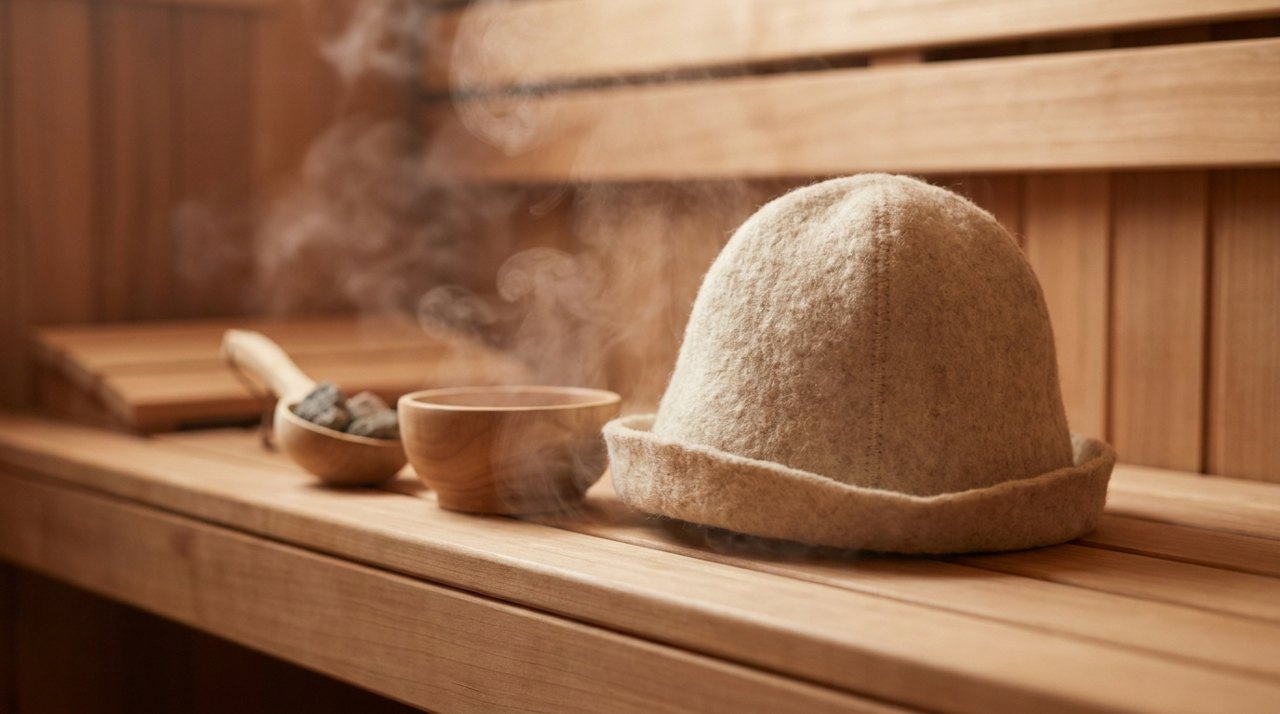
Every wool sauna hat starts the same way: a sheep gets a haircut. That simple fact — that the raw material grows back, every year, for the lifetime of the animal — is the foundation of wool's environmental case. But "natural" doesn't automatically mean "sustainable," and anyone who tells you wool has no footprint is selling something. Here's the honest accounting: where wool genuinely earns its green reputation, where it doesn't, and what to actually look for on a label.
Shearing is a harvest, not an extraction
Most materials in your life are extracted once. Polyester and acrylic — the fibers in nearly every cheap synthetic sauna hat — begin as crude oil pumped out of the ground. Cotton is renewable but demands enormous irrigation and pesticide inputs per kilogram of fiber.
Wool works differently. A sheep produces roughly 2 to 5 kilograms of fleece per year, and shearing isn't optional charity — domestic sheep breeds don't shed and must be shorn annually for their own welfare. Left unshorn, a sheep overheats, struggles to move, and becomes vulnerable to flystrike. The fleece is a byproduct of keeping the animal healthy, harvested with electric clippers and a skilled pair of hands, no drilling rig required.
One adult sheep's annual clip yields enough felt for several sauna hats. The same animal produces fiber again the next year, and the year after that, for a decade or more. That's the textbook definition of a renewable resource, and it's not a marketing stretch.
The end-of-life question: soil vs. microplastics
This is where wool wins most decisively, and it's worth being specific about why.
Wool is keratin — the same protein as your hair and fingernails. Buried in soil, a wool felt hat breaks down in roughly six months to a few years depending on conditions, releasing nitrogen, sulfur, and carbon that soil organisms actually use. Gardeners literally buy wool pellets as slow-release fertilizer. When your hat's decade of service finally ends, it can go in the compost.
An acrylic or polyester hat does not decompose in any timeframe that matters to a human life — estimates run 200 years and up. Worse, it sheds along the way. Every wash of a synthetic textile releases microplastic fibers; a single load can shed hundreds of thousands of them, and wastewater treatment doesn't catch them all. Those fibers are now found in ocean sediment, drinking water, and human blood. A sauna hat gets sweated into and rinsed regularly, so this isn't a hypothetical — it's the routine life of the product. I've written a fuller comparison of the two materials in Wool vs Synthetic Sauna Hats: The Material Truth, but the end-of-life gap alone settles most of the argument for me.
| Wool felt | Acrylic/polyester | |
|---|---|---|
| Raw material | Annual fleece harvest | Crude oil |
| Biodegrades | Yes — months to a few years in soil | No — 200+ years, fragments into microplastics |
| Shedding in use | Natural fibers, soil-compatible | Microplastic fibers per wash |
| Typical service life (sauna use) | 5–10+ years with care | Often 1–3 years before matting/deforming |
Longevity is sustainability you can count
The greenest product is the one you don't replace. Dense wool felt is remarkably durable in sauna conditions: it tolerates repeated 90 °C heat cycles without melting or deforming (synthetics soften and lose shape), it resists odor because lanolin residue and wool's fiber structure suppress bacteria, and felt has no knit structure to unravel — a small hole doesn't run.
Run the numbers. A quality felt hat like the the grey DIVELUX hat costs more upfront than a bargain synthetic, but a well-made felt hat routinely lasts five to ten years of weekly sauna use. A thin synthetic that mats and loses its insulating loft in two seasons has to be bought three or four times over the same period — more money, and three or four hats' worth of oil-derived fiber headed to landfill. Per year of use, the wool hat is usually the cheaper option outright. (If you want to push a hat toward the ten-year end of that range, the habits in How to Wash and Care for a Wool Sauna Hat matter more than anything on the label.)
The honest part: wool's real footprint
Now the caveats, because they're real and glossing over them helps no one.
- Methane. Sheep are ruminants. Like cattle, they belch methane, a potent short-lived greenhouse gas, and cradle-to-gate lifecycle studies consistently show wool with higher greenhouse emissions per kilogram of fiber than polyester. If you stop the analysis at the factory gate, wool loses on carbon. The full-lifecycle picture — decades of use, no microplastics, complete biodegradation, and the fact that fleece shares its footprint with meat from the same flock — narrows or reverses that gap, but the methane is not nothing.
- Land use. Sheep need pasture — far more land per kilogram of fiber than a polyester plant needs. The counterpoint: much sheep country is marginal land unsuitable for crops, and well-managed rotational grazing can maintain grassland ecosystems. Poorly managed grazing degrades them. Management is the variable, not the species.
- Animal welfare. Mulesing (a painful procedure practiced on some merino flocks, mostly in Australia) is the industry's ugliest issue. It's avoidable, and certifications exist precisely to verify that.
- Processing. Scouring raw fleece takes hot water and detergent, and conventional dyeing has its own chemistry. Undyed, natural-color felt — grey, brown, cream — skips the dye bath entirely, which is one quiet reason to prefer it.
Certifications worth looking for
Labels do a lot of lying in the wool world, so lean on third-party standards:
- RWS (Responsible Wool Standard) — audits animal welfare (including a mulesing ban) and land management on the farm.
- OEKO-TEX Standard 100 — tests the finished textile for harmful substance residues; especially relevant for something you wear on your head while sweating.
- GOTS (Global Organic Textile Standard) — organic fiber plus environmental criteria through processing; rare on felt goods but the gold standard where it appears.
- ZQ Merino — a New Zealand welfare and traceability program, worth knowing if you're shopping merino felt.
Just as important: read the fiber content line. "Wool blend" can legally mean mostly acrylic, which forfeits both the biodegradability and the heat performance. I've broken down the labeling games in What "100% Natural Wool" Really Means on a Sauna Hat Label. Honest makers state fiber content and felt weight plainly — the all seven colors does, and the classic grey is also available on Amazon if that's where you shop.
The verdict
Wool is not impact-free — the methane and land-use numbers are real, and pretending otherwise is greenwashing in the other direction. But for a sauna hat specifically, the case is strong: an annually renewable fiber, made into a product that survives a decade of extreme heat, sheds no plastic into the water supply, and returns to soil when it's done. The synthetic alternative is oil at the front end, microplastics in the middle, and landfill at the end — replaced two or three times over while your felt hat is still going strong. Buy one good hat, care for it, and the sustainability math takes care of itself.