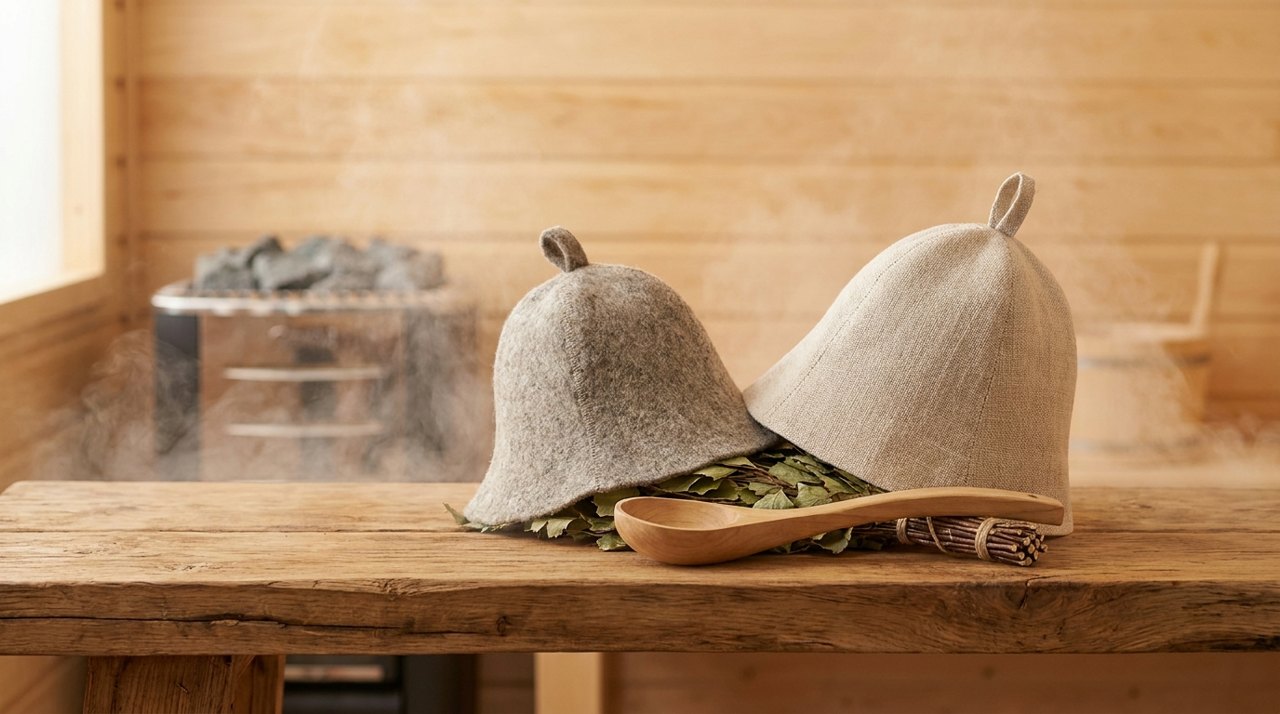
Walk into any traditional banya or Finnish sauna and you'll see two kinds of hats on the benches: thick grey wool felt cones and light, pale linen caps. Both are natural fibers, both have centuries of steam-room history behind them, and both get recommended interchangeably — which is a shame, because they do genuinely different jobs. Wool is an insulator; linen is a ventilator. Once you understand that distinction, choosing between them takes about ten seconds.
How each fiber actually works on your head
Wool felt is a mat of crimped fibers pressed into a dense, springy layer full of trapped air pockets. Air is a poor conductor of heat, so a 3–5 mm felt hat acts like a thermos for your skull: it slows the transfer of heat from the sauna air to your scalp and ears. That's the whole point. Your head sits at the hottest level of the room, and it's the part of your body least able to tolerate overheating — dizziness, headache, and that "I have to leave now" feeling usually start at the head, not the chest. A good felt hat lets the rest of your body get the full heat load while your head stays several degrees cooler, which in practice means longer, calmer sessions.
Linen works on the opposite principle. Woven flax is thin, smooth, and highly breathable. It doesn't trap much air, so it insulates only modestly — but it wicks moisture fast and lets it evaporate through the weave, which produces a mild cooling effect on the skin. A linen cap keeps your hair off your face, absorbs sweat at the brow, and takes the sting out of moderate heat without really blocking it.
Neither is "better." A thermos and a window screen are both useful; you just don't use them for the same thing.
Humidity: where the two materials diverge sharply
Humidity behavior is where the comparison gets interesting, because the two fibers handle water almost oppositely.
Wool can absorb up to roughly a third of its own weight in water vapor before it even feels damp, and — this is the remarkable part — it keeps insulating while it does so. The air pockets in felt stay largely intact even when the fiber itself is holding moisture. That's why a felt hat still protects you when someone throws a big ladle on the stones and the steam wave rolls across the ceiling. Steam carries heat far more aggressively than dry air, and that surge is exactly the moment a thin hat lets you down. Wool also releases heat slowly as it absorbs vapor, buffering sudden swings. We cover the physics of this in more detail in Wool in the Steam Room: Does a Felt Hat Work at 100% Humidity?, but the short version is: felt handles steam better than any other hat material.
Linen, by contrast, saturates quickly. In a wet steam room, a linen cap becomes a damp cloth clinging to your head within minutes. At mild temperatures that hardly matters. But once the air is hot enough, a saturated thin cap stops protecting and starts conducting: hot, wet fabric pressed against your scalp transfers heat faster than dry air would. In a 90–100°C löyly session, wet linen isn't just weaker than felt — it can be worse than nothing.
Temperature ranges: where each shines
| Conditions | Linen cap | Wool felt hat |
|---|---|---|
| Warm steam room, 40–60°C, high humidity | Excellent — breathable, sweat-wicking, comfortable | Works, but more protection than you need |
| Moderate sauna, 60–80°C | Adequate for short sessions | Comfortable, noticeably extends session time |
| Hot Finnish sauna, 80–100°C, top bench | Insufficient; ears and scalp feel it fast | Its home territory — this is what felt was made for |
| Steam waves / aufguss / banya parenie | Saturates and conducts heat | Buffers the steam surge, keeps insulating wet |
| Hammam, 40–50°C | Ideal | Overkill |
The rough dividing line is around 70°C. Below it, comfort and sweat management matter more than insulation, and linen's lightness wins. Above it, insulation is the job, and only felt does that job properly. If you regularly sit on the top bench of a real Finnish sauna, the choice isn't close.
Durability and care
Here the materials trade places in an unexpected way. Linen is famously durable as a woven fabric — flax fiber is stronger than cotton, and a linen cap tolerates machine washing, high spin speeds, even boiling. Care is trivial: throw it in with your towels. The trade-off is that a thin woven cap loses shape over time, hems fray, and after a couple of years of weekly saunas it starts looking like a rag, even if it technically still functions.
Wool felt demands more respect. You never machine-wash it hot — heat plus agitation is literally how felt is made, so a washing machine will shrink a hat two sizes. But the actual routine is lighter than people expect: shake it out, air-dry it after each session away from direct heat, and rinse it by hand in cool water a few times a year. Do that and a dense felt hat outlasts several linen caps; felt has no weave to unravel and no seams under tension across the crown. The full routine is in our guide to washing and caring for a wool sauna hat, and it takes maybe five minutes a month.
One more durability point that's easy to overlook: wool is naturally flame-resistant and chars rather than melts, which matters if you're the one tending a wood-fired stove. Linen scorches more readily. Neither will melt onto your skin the way polyester can — that comparison belongs to the wool versus synthetic discussion — but wool is the most fire-tolerant fabric you can wear in a hot room.
The verdict, by use case
- Hot dry sauna, top-bench sitter, aufguss fan: wool felt, no question. Look for dense felt around 4–5 mm thick with full ear coverage — something like the a thick felt hat like this one, a classic grey felt cone of exactly this type, also available on Amazon.
- Warm hammam or mild steam room only: linen. It's cooler, it wicks, and it washes without ceremony. Felt would be carrying insulation you don't need.
- Russian banya with heavy steam: wool felt again — this is the tradition it comes from, and saturated linen fails precisely when the venik steam hits.
- You do a bit of everything: own both; they're cheap relative to how much they improve a session. But if you're buying one hat, buy felt — it merely runs warm in a mild steam room, whereas linen actively fails in a hot one. Felt covers the whole range; linen covers half of it.
Whichever way you lean, insist on the genuine fiber — 100% wool felt or 100% flax linen, not a poly blend wearing a natural-sounding name. If you want to compare shapes, thicknesses, and colors side by side, the diveluxsaunahat.com is a good place to see what proper felt looks like. Your head does the hardest work in the hot room; give it the right tool for the temperature you actually bathe at.