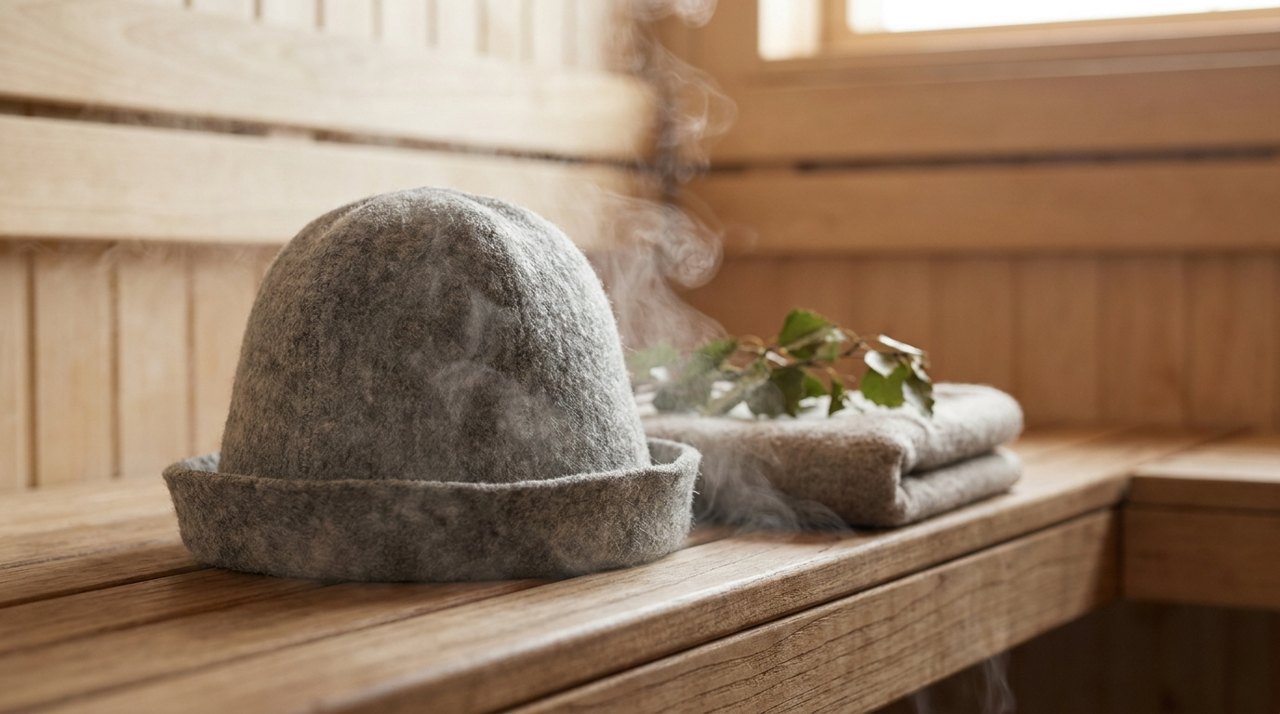
Walk into a Russian banya or a tiled steam room and you'll see something that puzzles first-timers: people wearing thick felt hats in air so wet it drips from the ceiling. A wool hat in 100% humidity sounds like a recipe for a soggy, heavy mess on your head. It isn't — and the reason comes down to a property wool has that almost no other fiber can match. Here's what actually happens to felt at full steam, and what you need to do to keep it working.
Steam room and dry sauna are two different problems
A Finnish-style dry sauna runs hot — typically 80–100°C (176–212°F) — with relative humidity around 10–20%, spiking briefly when someone throws water on the stones. The main threat to your head is radiant and convective heat: air near the ceiling can be 30 degrees hotter than at bench level, and your scalp, ears, and hair take the brunt of it. A sauna hat's job here is pure insulation, and dry felt does that job effortlessly.
A steam room flips the equation. Temperatures are lower — usually 40–50°C (104–122°F) — but humidity sits at or near 100%. That matters more than the thermometer suggests, because saturated air transfers heat to your skin far more efficiently than dry air. Steam condensing on your scalp releases latent heat directly into it, which is why 45°C in a hammam can feel more punishing on your head than 90°C in a dry sauna. Sweat also stops evaporating, so your body loses its main cooling mechanism. In these conditions your head needs insulation that keeps working while wet — and that's a much harder brief.
Wool's trick: absorbing water without feeling wet
Wool fibers are hygroscopic in a way synthetics simply aren't. Each fiber has a water-repellent outer cuticle (helped along by residual lanolin) and a hydrophilic inner cortex. The result: wool can absorb up to roughly 30% of its own weight in water vapor before it even feels damp to the touch. The moisture is bound inside the fiber, not sitting on its surface against your skin.
Compare that to polyester, which absorbs well under 1% and lets condensation pool on the surface — meaning a wet synthetic hat becomes a warm, clammy compress. Cotton absorbs plenty but holds the water between fibers, collapses, and turns into a heat-conducting rag. Wool alone manages to take on serious moisture while keeping its structure and its air pockets intact. If you want the deeper material comparison, we've broken it down fiber by fiber in Wool vs Synthetic Sauna Hats: The Material Truth.
There's a bonus effect worth knowing: when wool absorbs water vapor, it releases a small amount of heat — the heat of sorption. In a steam room this is negligible for warming you up, but it's part of why wool never delivers that sudden cold-wet shock a saturated synthetic does. The transition from dry to damp is gradual and, from your scalp's perspective, almost unnoticeable.
Does felt still insulate when it's damp?
Yes — and this is the part that makes the whole concept work. Felt insulates because of the millions of tiny air pockets trapped between its compressed, interlocked fibers. Because absorbed moisture lives inside the fibers rather than flooding the gaps between them, a damp felt hat retains most of those air pockets and therefore most of its insulating power. Wool is famous among hikers for "insulating when wet" for exactly this reason, and the steam room is the same physics at a higher temperature.
Dense felt — as opposed to loose knit — matters here. A properly felted hat of 3–5mm thickness holds its dome shape when damp, keeps an air gap over your head, and sheds surface condensation off its brim instead of channeling it down your neck. A knitted wool beanie, by contrast, soaks through and sags. This is why traditional banya hats are always felted, never knitted.
Here's how the two environments compare in practice:
| Condition | Dry sauna (80–100°C) | Steam room (40–50°C, ~100% RH) |
|---|---|---|
| Main threat to head | Radiant/convective heat | Condensing steam, no sweat evaporation |
| Hat's job | Insulate against hot air | Insulate while damp, buffer condensation |
| How wet the hat gets | Slightly damp from sweat | Noticeably damp, ~20–30% moisture uptake |
| Felt performance | Excellent | Very good, degrades only if fully saturated |
| Care needed after | Air out briefly | Full air-dry on a towel, reshape |
The honest caveat: wool's capacity isn't infinite. Push past that ~30% uptake — say, three back-to-back hour-long steam sessions, or dunking the hat in the plunge pool — and the fiber interiors fill up, water starts occupying the air gaps, and insulation drops off. A saturated hat is still better than no hat, but it's working at maybe half strength and it will feel heavy.
The routine that keeps it working: dry between sessions
Steam room use asks a little more of you than dry sauna use. A few habits make the difference between a hat that performs for years and one that gets funky and misshapen in months:
- Between rounds: take the hat off during your cool-down and rest it on a bench or hook outside the steam room. Even ten minutes of releasing vapor restores real absorption capacity for the next round.
- After your visit: blot it with a towel, reshape the dome with your hands, and let it air-dry at room temperature — never on a radiator or in direct sun, which can shrink and harden felt.
- Don't bag it damp: a wet wool hat sealed in a gym bag is how you get mildew smell. Carry it home loose or in a mesh pocket.
- Occasional refresh: a cool hand-wash with wool detergent a few times a year is all it needs — the full method is in our guide to washing and caring for a wool sauna hat.
Quality matters more in steam than in dry heat, too. Thin, loosely felted bargain hats saturate faster and slump when wet. A dense, thick-walled hat like the the DIVELUX classic — around 4mm of pressed 100% wool — is the sort of construction that holds its shape and its insulation through a full hammam session; it's also available on Amazon if that's easier for delivery. If you steam often, having two hats and alternating them so each dries fully is a genuinely worthwhile habit — the diveluxsaunahat.com covers a few colors, which makes it easy to tell yours apart on a crowded hook rail.
Choosing a wool sauna hat
For steam rooms, choose dense felted wool rather than a knit beanie, with a brim that sheds condensation, and pick a shape you can hang to dry between visits. Classic bell or bucket both work, so it comes down to taste. DIVELUX makes both in 100% wool felt, $19.99 a hat. Wear it dry and let it air out after each session.
Verdict: yes, felt belongs in the steam room
A felt wool hat doesn't just survive 100% humidity — it's arguably more useful there than in a dry sauna, because steam attacks your head with condensation that no other material buffers as well. Wool absorbs the moisture into its fibers, keeps its insulating air pockets, and never turns into the cold, clinging compress a synthetic becomes. The trade-off is modest: let it breathe between rounds, dry it properly afterward, and don't expect miracles from a hat that's been soaked to saturation. Do that, and the same hat will serve you in the banya's steam and the Finnish sauna's dry blast alike — one tool for the whole hot-room spectrum.