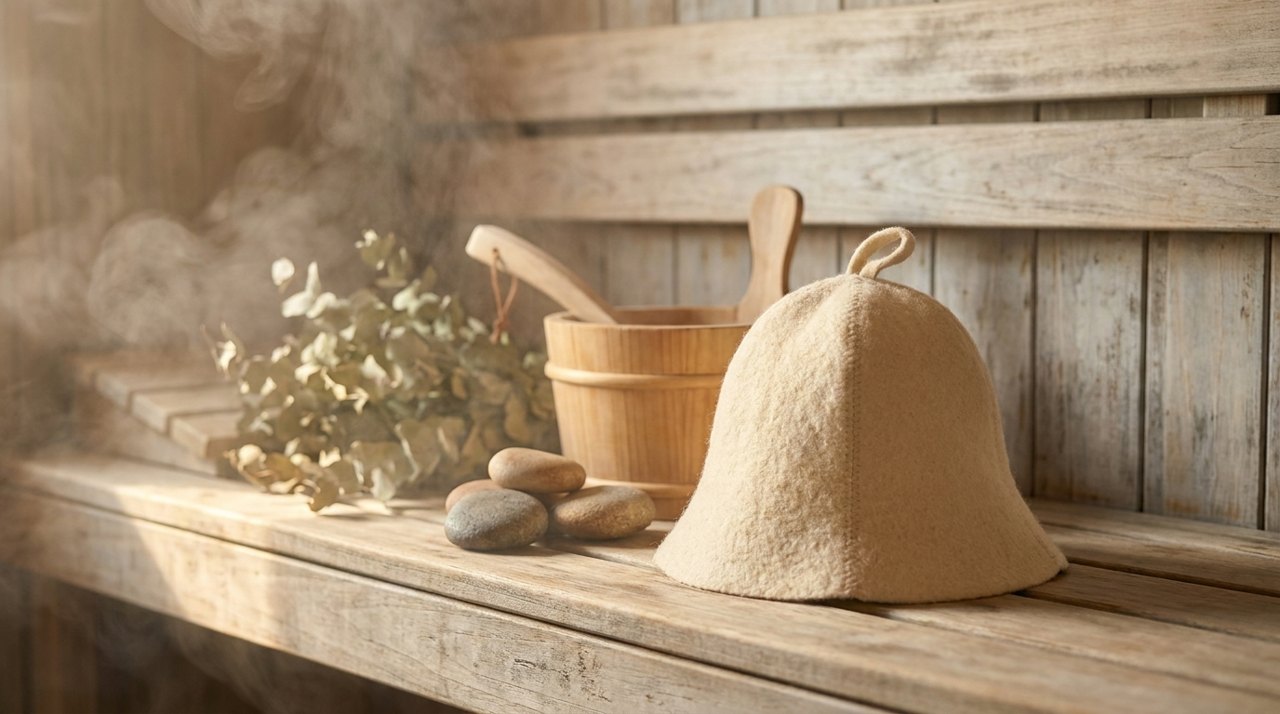
Wool has an itchy reputation, and it's mostly earned — by sweaters. A sauna hat is a different animal. Most people who put on a good felt hat for the first time report "thick and slightly stiff" rather than "prickly," and the sensation fades within a handful of sessions. But "most people" isn't everyone, and some itching is a real warning sign rather than a break-in phase. Here's what normal feels like, what changes with use, and how to tell honest wool scratch from the sharper irritation of a synthetic blend.
The reason a wool sweater itches is geometry. In a knit, individual fibre ends stick out of the yarn surface at right angles and press into your skin as isolated points. Nerve endings read a coarse fibre end pushing at roughly 100 milligrams of force as pain, not touch — that's the "prickle" response, and it's mechanical, not allergic.
Felt is made by agitating loose fleece with heat, moisture and pressure until the scales on each fibre interlock into a dense mat. There is no yarn, no loop structure, and far fewer free ends standing proud of the surface. Instead of a field of tiny spikes, you get a compressed, slightly fuzzy plane. The pressure spreads. That's why a 5 mm felt crown against your forehead feels like firm padding, while a knit beanie of the same wool feels like sandpaper.
| Factor | Felted wool hat | Knitted wool hat |
|---|---|---|
| Surface structure | Dense mat, few protruding ends | Loops with many exposed fibre tips |
| Skin sensation | Broad pressure, mild fuzz | Point contact, classic prickle |
| Heat insulation when wet | Holds air pockets, stays lofty | Collapses, conducts heat faster |
| Behaviour over time | Softens and moulds to head | Stretches, sags, pills |
This is one of several reasons the traditional Finnish and Russian hat has always been felt rather than knit — the comfort advantage is a side effect of the thermal one. We go deeper into that in Felted vs Knitted Wool: Why Sauna Hats Are Always Felt.
For anyone with a full head of hair, actual wool-to-skin contact is limited to a narrow band: the forehead line, sometimes the tops of the ears, and the nape if the hat sits low. Everywhere else, hair sits between felt and scalp. That's why people with shaved heads and people with thick hair often describe the same hat completely differently.
If you're bald or close-cropped, the whole crown is contact area, and you'll notice texture that a long-haired sauna partner genuinely does not feel. This isn't a defect in the hat — it's a real difference in exposure, and it's the main case where the liner tricks below are worth the trouble.
A new hat is at its stiffest the day it arrives, because it's been pressed and dried flat since manufacture. Three things soften it:
Realistic timeline: noticeably softer after 3–5 sessions, fully broken in around 10–15. A cold hand-wash in wool detergent about a month in accelerates it — wetting and gently working the felt relaxes it more in ten minutes than several sessions do. Do it properly, though; the method matters and hot water plus wringing will shrink the hat instead. See How to Wash and Care for a Wool Sauna Hat (So It Lasts Years).
One shortcut: before your first session, dampen the hat under cool water, squeeze out the excess without twisting, and put it on. You skip the stiffest phase entirely, and a pre-dampened hat runs cooler anyway.
Some people have reactive skin, eczema, or simply a low prickle threshold. None of that means wool is off the table — it means you manage the contact band.
A well-made classic like the DIVELUX wool sauna hat is dense enough that the brim holds its shape without cinching, which is half the comfort battle; it's also available on Amazon if you'd rather not wait on international shipping. Lined and embroidered versions in the DIVELUX sauna hats collection put a fabric layer at the brow by design, which is worth considering if you know your skin is fussy.
Here's the distinction that matters. Wool prickle is broad, dull, present the moment the hat goes on, and fades as you acclimatise. Synthetic irritation is different:
Cheap "wool" hats are frequently 30–50% acrylic or polyester, sometimes undeclared. Those fibres don't just underperform thermally — they soften when hot, hold heat against your skin, and can genuinely scald in a way real wool cannot. The burn test on a snipped fibre is the fastest check: wool self-extinguishes and smells like burnt hair, synthetics melt into a hard bead and smell like chemicals. More on reading labels honestly in Wool vs Synthetic Sauna Hats: The Material Truth.
The honest summary: a decent felt hat is mildly scratchy for the first few sessions and then isn't. If yours is still irritating after fifteen uses and a wash, the problem is the hat's composition or its fit, not your tolerance — and neither is something you should have to put up with.
Handmade from 100% natural wool felt. 7 colors, classic and bucket styles, one size fits most. $19.99 with free US shipping and 30-day returns.
Shop DIVELUX sauna hats →