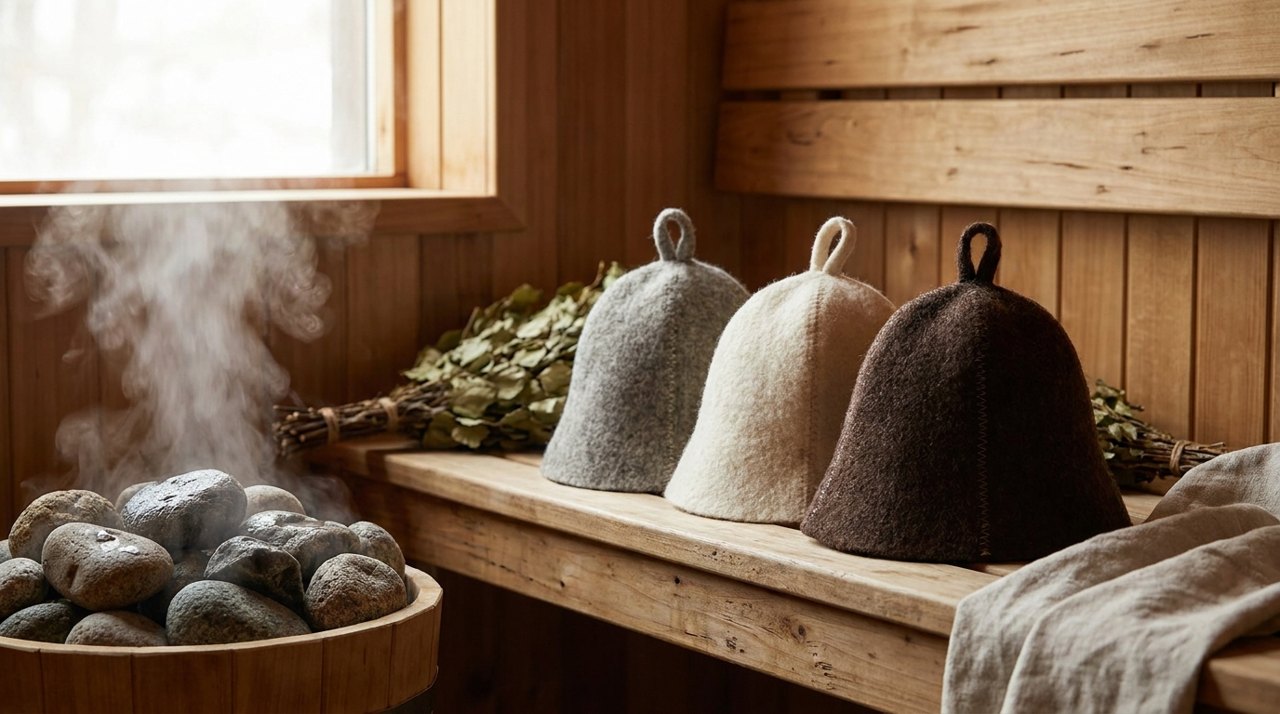
Pick up a handful of raw fleece straight from shearing and you'll notice something most people never think about: sheep don't come in one color. Cream, silver-grey, oatmeal, chocolate brown, near-black — these shades exist in the wool before anyone touches a dye pot. The best sauna hats simply keep them. Understanding where those natural colors come from, and how they differ from dyed felt, tells you a lot about what you're actually buying — and why an undyed hat tends to look better at year five than a dyed one looks at year one.
Wool color is genetics, not processing. The pigment involved is melanin — the same family of pigments that colors human hair — deposited in the fiber as it grows. Most commercial sheep breeds have been selected for centuries to produce white wool, because white fleece takes dye predictably and fetches more at market. But plenty of breeds still carry the older pigmented genes: Gotland sheep grow that distinctive silvery grey, Shetlands come in eleven recognized natural shades from white through moorit (a warm reddish brown) to black, and Jacob sheep famously grow patched fleeces of dark and light on the same animal.
What we call "grey" wool is usually not grey fiber at all. It's a blend — dark and white fibers growing together in the same fleece, or blended during carding. Look closely at a natural grey felt hat and you'll see it: individual fibers of near-black, mid-brown, and cream, optically mixing into grey the way a newspaper photo mixes dots into tone. That heathered depth is impossible to fake with a single dye bath, and it's the easiest tell that you're holding genuinely undyed wool.
Here's the practical part. A sauna hat lives a hard life: repeated soaking in sweat, temperature swings from 100°C to room air, UV exposure if it dries on a windowsill, occasional washing. Every one of those stresses attacks dye faster than it attacks the fiber itself.
Dyed felt fades from the surface inward. The outer fibers lose color first, so a dyed hat develops pale, chalky patches at the fold lines and wherever you grab it — visible wear that reads as shabby. Undyed wool can't fade in the same way, because the color runs through the entire fiber. The melanin is inside the cortex, not sitting on the surface. A natural grey hat at five years old looks like a natural grey hat: slightly fuzzier, a bit more felted, maybe darkened at the brim from lanolin and handling, but the color itself is intact. The patina reads as character rather than decay.
There's a chemistry angle too. Acid dyes bond to wool at high temperature in an acidic bath — a process that, done aggressively or cheaply, degrades the fiber's scales and reduces its strength and elasticity. Undyed felt skips that entire chemical episode. The wool arrives in your hat having endured one less hot, acidic ordeal, which matters for something you're going to steam-cycle a hundred times a year. If you're curious how long that translates to in practice, we've broken it down in How Long Does a Wool Sauna Hat Last? (And How to Double It).
One honest caveat: undyed wool isn't fully immune to change. Prolonged direct sunlight will slowly yellow white wool and can soften very dark shades. But this happens over years, evenly, and gently — nothing like the blotchy fade of a cheap dye job.
Because natural wool comes in a real palette, felters can build color into the construction of the hat rather than applying it afterward. Two-tone hats are the classic expression of this: a grey body with a cream brim band, a brown crown with a natural white edge, or contrasting embroidery-zone panels laid in during the felting itself.
Done properly, the shades aren't stitched together — they're felted together. During wet felting, fibers of both colors migrate across the boundary and lock into a single continuous piece of felt (the process is worth understanding; see How Wool Sauna Hats Are Made: From Fleece to Felt). The color transition on a well-made two-tone hat is slightly soft, with a few fibers of each shade crossing the line. A razor-sharp boundary usually means two pieces of pre-made felt were sewn together, which introduces a seam — a weak point and a heat leak you don't want on your head at 90°C.
Combinations that work well, from watching a lot of hats come through public saunas:
The market has plenty of hats that imitate the natural-wool look: polyester or acrylic felt, dyed to a flat "wool grey," sometimes labeled with creative phrases like "wool-touch" or "felt blend." Beyond aesthetics, this matters for safety and function — synthetics soften and can melt at sauna temperatures, and they insulate poorly when damp. We've covered the performance gap in Wool vs Synthetic Sauna Hats: The Material Truth, but color alone gives you several quick checks:
| What to look at | Natural undyed wool | Dyed synthetic |
|---|---|---|
| Color up close | Heathered — individual fibers of different shades visible | Uniform, flat tone; every fiber identical |
| Color inside vs outside | Same throughout the felt thickness | Sometimes paler in the cut edge or interior |
| Sheen | Matte, slightly dry-looking | Faint plastic luster, especially under direct light |
| Smell when warm/damp | Faint lanolin, "sheepy" | Neutral or vaguely chemical |
| Wet test | Water absorbs; damp wool smells like wool | Water beads or soaks with no smell change |
The smell test is more reliable than it sounds — genuine wool announces itself when it warms up, and that's a feature, not a flaw (we wrote a whole piece on it: Why Your New Wool Sauna Hat Smells). If you're inspecting online listings rather than a physical hat, look for close-up photos showing fiber-level texture, and be suspicious of hats offered in twelve saturated colors: teal, lime, and hot pink don't grow on sheep, and while dyed real wool exists, a rainbow lineup at a bargain price usually means polyester.
A trick for online shopping: zoom into product photos of the brim edge. Natural felt shows slightly irregular fiber ends and shade variation there; die-cut synthetic felt shows a clean, uniform edge like craft-store sheet felt.
Functionally, all natural shades insulate identically — color is pigment, not structure. So the choice comes down to how the hat will live. White is the traditional Russian banya look and shows embroidery beautifully, but it displays every splash and smudge. Grey is the practical default: it hides wear, suits the heathered aesthetic, and ages the most gracefully of all. Brown sits in between — warm, distinctive, and forgiving. If you want to compare the natural range side by side, the DIVELUX sauna hats collection covers the classic undyed shades, and the grey is also available on Amazon if that's where you prefer to order.
Whatever shade you choose, the principle holds: color that grew on the sheep outlasts color added in a factory. An undyed hat doesn't fade, doesn't bleed in the wash, and skips a round of chemical processing that its dyed cousins endured. It's one of the rare cases where the more honest product is also, quietly, the better-looking one a few hundred sauna sessions down the road.
Handmade from 100% natural wool felt. 7 colors, classic and bucket styles, one size fits most. $19.99 with free US shipping and 30-day returns.
Shop DIVELUX sauna hats →