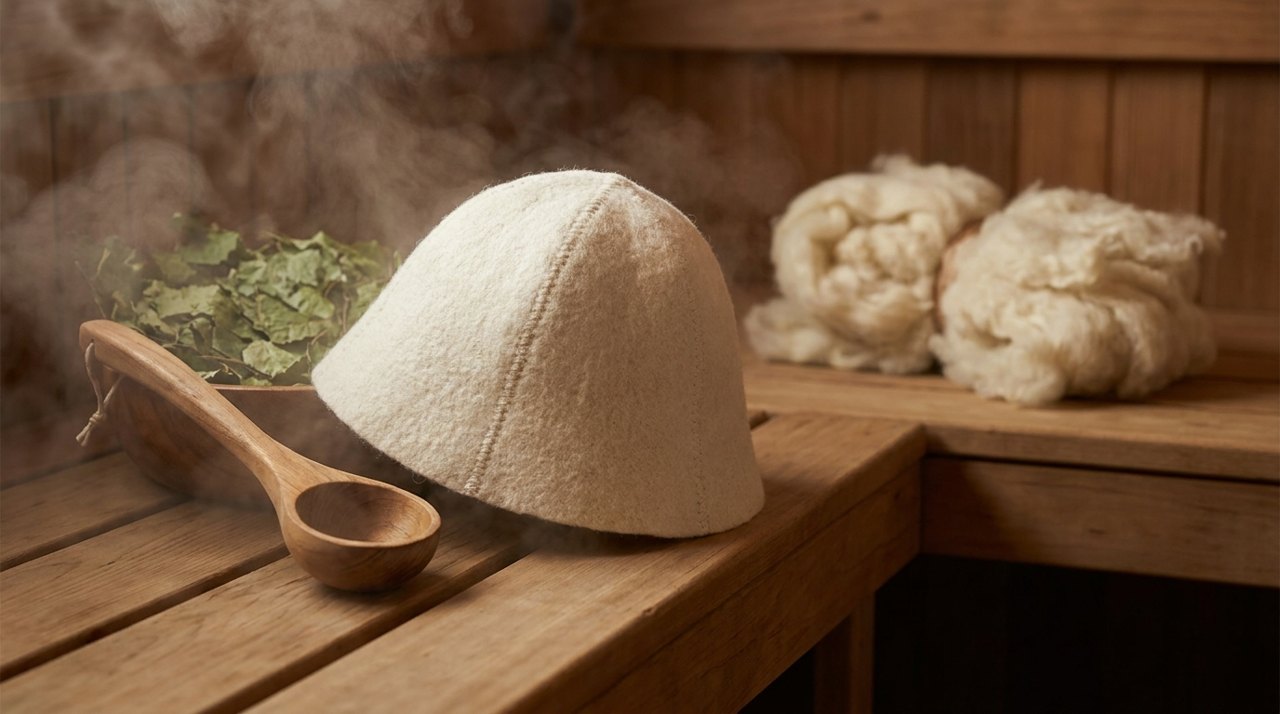
A good wool sauna hat looks deceptively simple — a thick grey dome with a stitched brim — but between the sheep and the sauna bench sits a surprisingly long chain of handwork. Felting is one of the oldest textile techniques humans know, older than weaving or knitting, and the way a sauna hat is felted determines almost everything about how it performs: how well it insulates, how it holds its shape over years of steam, and whether it survives its hundredth löyly or sags after its tenth. Here is how the process actually works, step by step.
It starts with the fleece
Not all wool felts equally well. Felting depends on the microscopic scales that cover each wool fiber — under heat, moisture, and friction, those scales open up and lock into neighboring fibers like thousands of tiny barbs. Coarser wools with pronounced scales, typically in the 25–32 micron range, felt readily and produce a dense, resilient fabric. Ultra-fine merino, prized for next-to-skin softness in clothing, actually felts into a thinner, floppier fabric that lacks the body a sauna hat needs to stand up off your head.
Makers therefore select medium-grade fleece from breeds like Romney, Corriedale, or regional coarse-wool sheep. The fleece is sorted by hand: belly wool, matted sections, and vegetable matter (hay, burrs) are pulled out, keeping only the long, clean staples from the back and sides of the animal. This sorting stage is invisible in the finished hat, but skipping it shows up later as thin spots and embedded debris.
Washing and carding: preparing the fiber
Raw fleece is greasy. Lanolin — the sheep's natural waterproofing wax — can make up 10–25% of the fleece's weight, along with dirt and dried sweat. The wool is scoured in warm water with mild detergent, gently, because aggressive agitation at this stage would start felting the loose fiber prematurely into useless clumps. Scouring removes most of the lanolin, but never all of it, and that's deliberate: the residual lanolin gives felt some of its water resistance and that faint farmy smell a new hat has. (If yours smells like a barn on day one, that's actually a good sign — it means the wool wasn't chemically stripped.)
Dried wool then goes through carding — brushing the fibers between fine-toothed drums or hand carders until they lie roughly parallel in airy, cloud-like sheets called batts. Carding matters more than it sounds. Even, well-opened batts felt into even fabric; lumpy carding produces felt with dense and thin zones that wet out and wear unevenly.
Wet felting: soap, hot water, and a lot of rubbing
Now the actual felting. The maker lays out carded wool in thin, overlapping layers, alternating the fiber direction with each layer — one layer running north–south, the next east–west. A sauna hat typically gets four to eight layers, laid out flat around a resist (a template of plastic or dense foam in the shape of the hat, slightly oversized to allow for shrinkage). Wool is wrapped around both sides of the resist so the hat forms as a seamless pocket — no sewn seams to leak heat or split.
Then comes hot soapy water. The soap does two jobs: it lubricates the fibers so they can slide past each other, and its alkalinity swells the fiber and lifts the scales so they catch. The maker presses, rubs, and rolls the soaked wool — first gently through a mesh so the layout doesn't shift, then with increasing force. This stage can take an hour or more of continuous handwork for a single hat.
- Wetting out: hot soapy water is sprinkled over the layout and pressed through until every fiber is saturated.
- Gentle rubbing: circular hand pressure begins tangling the surface fibers. The piece is still fragile.
- Rolling: the work is rolled up in a bamboo mat or textured cloth and rolled back and forth hundreds of times, rotating regularly so shrinkage stays even in all directions.
- Fulling: the toughest stage — the felt is kneaded, thrown against the table, and shocked with alternating hot and cold water to drive maximum shrinkage and density.
By the end, the wool has shrunk 30–40% from the original layout and transformed from fluff into a firm, dense fabric you cannot pull apart. This is why sauna hats are always felted rather than knitted — felt traps still air in a rigid structure that holds itself off your scalp, which is precisely the insulating gap that keeps your head cool at 90 °C.
Shaping on the form
The resist is cut out and removed, and the still-damp hat goes onto a wooden or foam hat block. Here the maker stretches, smooths, and pounds the felt into its final geometry — the height of the dome, the flare of the brim, the crispness of the fold. The hat dries on the block over a day or two, and because felt has shape memory, it will return to this blocked form for years, even after years of hot-room sessions.
This is also where quality differences become visible. A well-fulled, well-blocked hat stands up on a table under its own structure. An under-felted one slumps. If you press a fingertip into the crown of a hat like the DIVELUX's $19.99 classic, the felt should feel springy and uniformly thick — around 3–5 mm — with no soft spots where layers were laid thin.
Finishing and decorative stitching
Once dry, the brim edge is trimmed even and usually finished with blanket stitch or a simple overcast in contrasting or matching yarn. The stitching is partly decorative, but it also does structural work: a stitched edge resists stretching and fraying at the one place the hat gets handled most — where you grab it to pull it on and off. Some makers add embroidered motifs, appliqué felt shapes, or a small hanging loop. On handmade hats you can usually see slight irregularity in the stitch spacing; that's the signature of a needle, not a machine.
Why hand felting beats factory pressing
Mass-produced felt hats exist, and they're cheaper for a reason. Industrial felt is typically made by needle-punching (barbed needles mechanically tangling fibers) or by pressing wool between heated rollers. Both are fast, and both produce a fundamentally different fabric.
| Hand wet-felting | Factory pressing / needling | |
|---|---|---|
| Fiber entanglement | Three-dimensional, through the full thickness | Mostly surface and vertical punch points |
| Density | High and adjustable — the maker fulls until the felt is right | Set by machine time; usually looser |
| Evenness | Checked and corrected by hand during rolling | Thin spots pass through uninspected |
| Seams | None — formed as one piece on a resist | Often cut and sewn from flat sheet |
| Shape retention | Blocked-in memory, recovers after steam | Tends to relax and slump with use |
The practical difference shows up on the bench. Denser, evenly felted wool insulates more consistently, absorbs steam without collapsing, and shrugs off years of use — a hand-felted hat can genuinely last a decade with basic care. Pressed felt often works fine for a season, then thins at the crown exactly where the heat load is highest.
What this means when you're buying
You can read the making process off the finished hat. Look for a seamless body, a firm springy hand, visible (slightly irregular) edge stitching, and a label that honestly says 100% wool. Weight is a clue too — a proper felted adult hat usually lands between 100 and 180 grams; suspiciously light hats are either thin or blended with synthetics. Hand-felted hats in the classic Nordic and Russian banya styles are easy to find online — DIVELUX sells theirs directly through the the store and on Amazon — but whatever brand you choose, the fingertip test and the seam check will tell you most of what the label won't.
And once you own one, the same qualities that come from careful felting are easy to preserve: rinse, air-dry on something head-shaped, and never machine-wash. We cover the full routine in our guide to washing and caring for a wool sauna hat — because a hat that took hours of handwork to make deserves the five minutes of care that keeps it working.