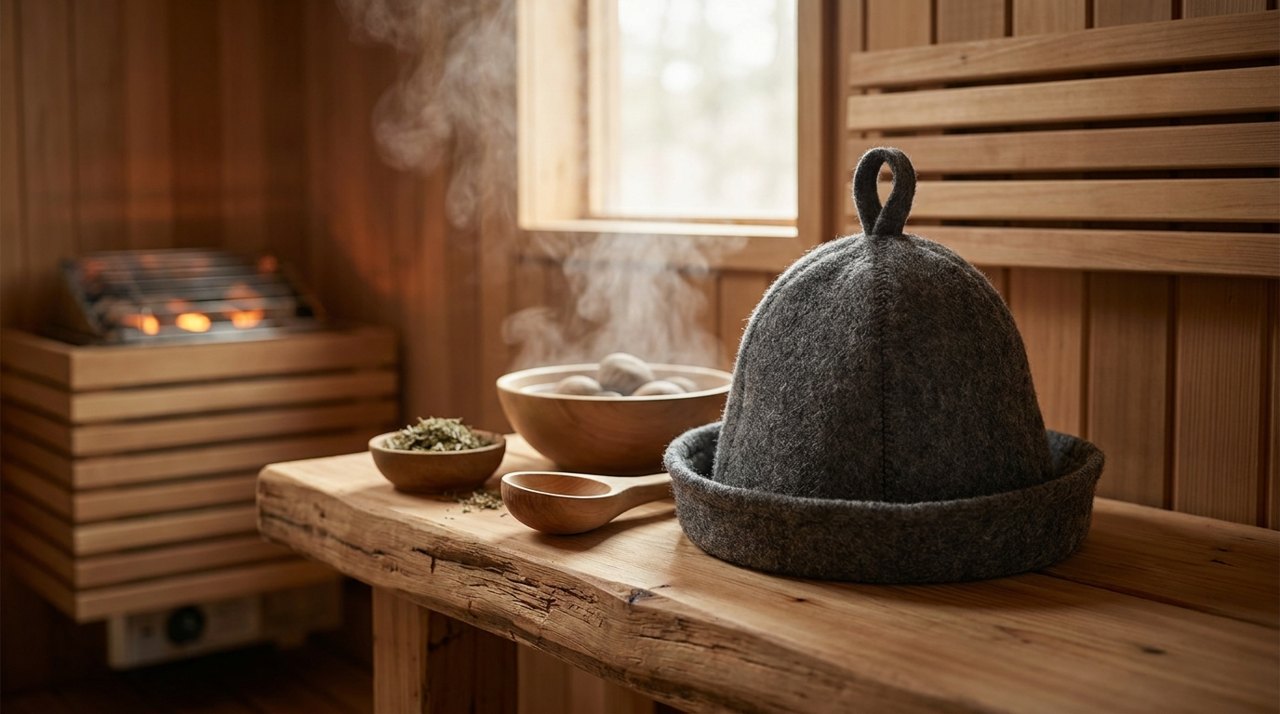
A well-made felted wool sauna hat should last five to ten years of regular use — some people are still wearing hats they bought over a decade ago. A cheap synthetic one often looks tired after a single season. The difference isn't luck. Felt degrades in a few specific, predictable ways, and almost all of them are caused by the owner, not the sauna. Avoid four habits, add two easy ones, and you can realistically double the working life of any wool hat you own.
What actually wears out a felt hat
Heat is not the enemy. Wool is built for heat — it doesn't melt, it barely absorbs radiant warmth, and a session at 90°C does essentially nothing to the fiber. (If you're curious just how heat-tolerant wool is, see why wool is the fire-safe choice for the hot room.) What kills felt is mechanical and chemical abuse between sessions. Four things account for nearly every dead sauna hat I've seen:
- Wringing. Twisting a wet hat to squeeze water out is the fastest way to destroy it. Wet wool fibers are weak and stretchy; wringing pulls them past their recovery point and warps the dome permanently. A wrung hat comes back lumpy and never sits right again.
- Machine washing. A washing machine does to felt exactly what felting does to raw wool — agitation plus moisture plus temperature swings — except your hat is already felted, so it just keeps shrinking and hardening. One hot cycle can take a hat down a full size and turn the soft wall into cardboard.
- Radiators and direct heaters. Drying a soaked hat on a radiator, on top of the sauna stove, or with a hair dryer forces moisture out too fast. The felt shrinks unevenly, gets brittle, and the brim curls. Fast drying is the second most common killer after wringing.
- UV exposure. Leaving a hat on a sunny windowsill or an outdoor hook for weeks bleaches the color and slowly embrittles the fiber. Sunlight damage is gradual, so people rarely connect the cause to the effect — but a hat stored in sun ages years faster than one stored in a drawer.
Notice what's not on the list: sauna use itself. A hat that lives its whole life going into the hot room and drying gently afterward is barely aging at all.
Pilling: normal, and fixable
Somewhere in the first months you'll see small fuzzy balls forming on the surface, usually where the hat rubs — the brim, the spot where you grab it to take it off. This is pilling, and it's not a defect. Felt is a mat of millions of short fibers; the loosest ones on the surface work free and tangle into little pills. Every felted product does this, from hats to boiled-wool slippers.
Handle it in thirty seconds: pick pills off by hand, or shave them with a fabric comb or an electric fabric shaver on the lightest setting. Don't pull hard — you'll drag out fibers that were still anchored. Pilling slows down dramatically after the first year, because once the loose surface fibers are gone, the remaining ones are locked in. A hat that's been de-pilled twice often barely pills again.
Reshaping a hat that's lost its dome
Felt has a useful property: it's re-mouldable when damp. If your hat has been squashed in a gym bag or dried into a slightly wrong shape, you don't need to live with it.
- Dampen the hat evenly with cool, room-temperature water — wet enough to be pliable, not dripping.
- Put it over a form roughly the size of your head: an upturned bowl, a ball, a pot. Or simply wear it for ten minutes.
- Smooth the dome and brim with your palms into the shape you want.
- Leave it on the form to air-dry completely, away from any heat source.
This works because felted wool has no knit structure to distort — it's an isotropic mat that holds whatever shape it dries in. (That's also why sauna hats are always felt rather than knit; the full explanation is in felted vs knitted wool.) You can reshape a hat dozens of times over its life with no penalty.
Rotate if you sauna more than twice a week
The single habit that most extends felt life for frequent sauna-goers is boring: own two hats and alternate them. A hat needs 24–48 hours to dry fully through its thickness. If you sauna daily with one hat, it never completely dries, and perpetually damp felt compresses faster, holds odor, and loses loft. Two hats in rotation each get a full dry cycle, and each sees half the wear — so a pair doesn't just last twice as long as one hat, it lasts longer than that, because neither is ever abused while damp. At around $20–30 for a solid hat like the this handmade wool felt hat, a rotation pair is a cheap upgrade; if you want the second hat in a different color so household members stop mixing them up, the the store covers that, and the grey classic is also available on Amazon.
When to retire a hat
Wool degrades gracefully, so the retirement signs are functional, not cosmetic. Fading, pilling, and a slightly relaxed shape are fine — a broken-in hat often works better than a new one. Retire it when:
- The wall has thinned noticeably. Hold it up to a bright light; if you can see light through patches, the insulation is gone and your head will feel it on the top bench.
- The felt has gone hard and boardy all over — usually the aftermath of machine washing or repeated radiator drying. Hardened felt insulates worse and cracks at the folds.
- It no longer covers your ears and forehead after cumulative shrinkage, and re-stretching while damp won't bring it back.
- Seams have failed beyond a simple hand-stitch repair.
An honest benchmark: 2–4 years for a heavily used hat that's been treated carelessly, 5–10 for one that's been dried flat and never wrung.
The math against cheap synthetics
| Real felted wool (~$20–25) | Synthetic felt (~$8–12) | |
|---|---|---|
| Typical lifespan | 5–10 years with basic care | 1–2 seasons |
| Failure mode | Gradual thinning | Matting, melting near the stove, permanent odor |
| Repairable? | Yes — reshape, de-pill, re-stitch | Rarely; matted synthetic can't be revived |
| Cost over 6 years | ~$20–25 | ~$30–50 across replacements |
Synthetic "felt" is usually needle-punched polyester, and it fails differently: the fibers mat down and stay matted, the material can glaze or deform near a hot stove, and sweat odor bonds to plastic in a way it never does to wool. So you end up buying three cheap hats over the same period one wool hat quietly serves — and getting worse insulation the whole time. The full comparison is in wool vs synthetic sauna hats.
The two-minute routine that doubles a hat's life
Everything above condenses to this. After each session: press the hat gently between your palms if it's damp — never twist — then let it air-dry on a shelf or hook away from the stove, radiator, and sun. That's it. Add an occasional reshape and a de-pilling once or twice a year, and you've eliminated every major cause of felt death. A hat treated this way doesn't really wear out; it just slowly, gracefully breaks in.