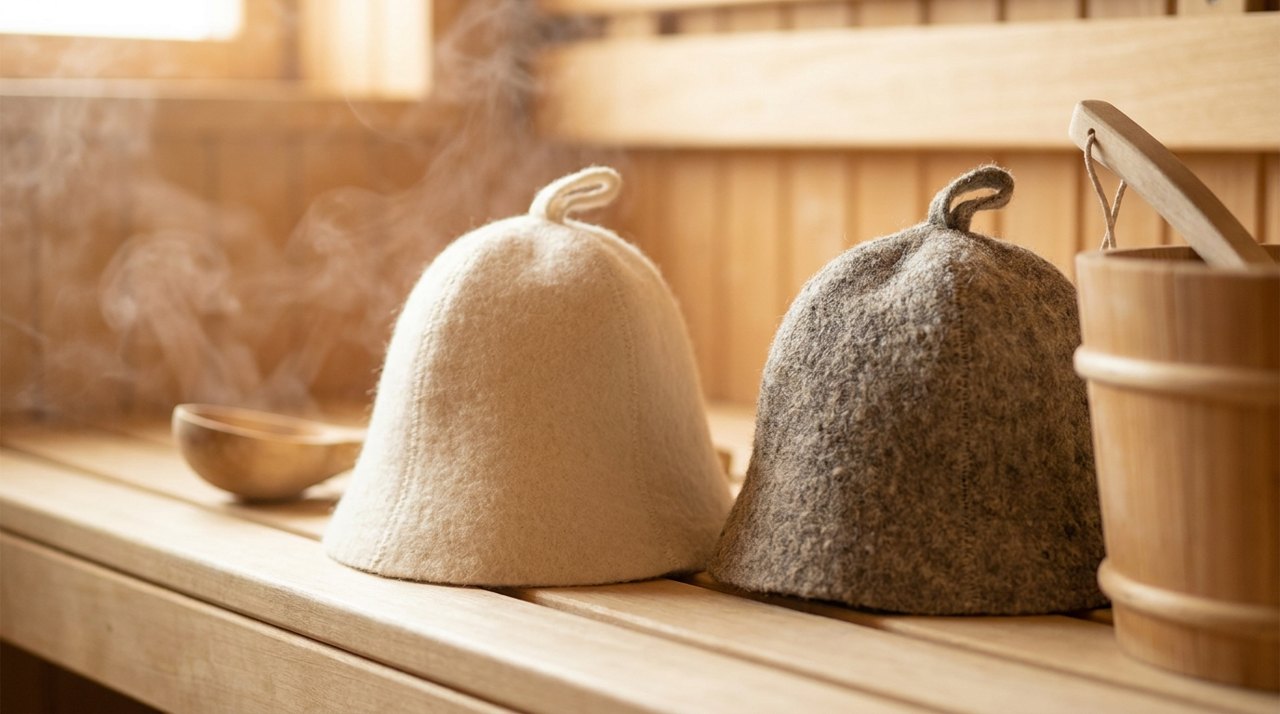
When shopping for wool garments, we have been conditioned to look for one word above all others: Merino. It is the undisputed gold standard for base layers, hiking socks, and winter sweaters. But when it comes to the extreme environment of a 200°F (90°C) sauna, the rules of textile selection flip upside down. Choosing between Merino and coarse wool felt for a sauna hat isn't just a matter of softness—it is a delicate balancing act between fiber diameter, felting density, and thermal resistance.
To understand why these two types of wool behave so differently in the hot room, we have to look at them under a microscope. Wool is measured in microns (one-millionth of a meter), which dictates the thickness of individual hair fibers.
Merino wool is prized precisely because its fibers are incredibly fine, typically ranging from 15 to 24 microns. Because these fibers are so thin, they bend easily when they press against your skin, which is why Merino feels soft and luxurious rather than prickly.
Coarse wool—often sourced from traditional sheep breeds raised in harsher climates—typically measures anywhere from 27 to 40+ microns. These fibers are thicker, far more rigid, and have a more pronounced scale structure on their outer cuticles. In a knitted sweater, these rigid fibers would poke your skin and cause itching. But in a sauna hat, this rigidity is exactly what you want.
The primary job of a sauna hat is not to warm your head, but to insulate it against external heat. To do this, the hat must maintain a stable microclimate of cooler air around your scalp and ears. Air is an incredibly poor conductor of heat, making it a fantastic insulator—provided you can trap it effectively.
As we have noted in our guide on why sauna hats are always felted rather than knitted, the felt-making process relies on heat, moisture, and friction to permanently lock wool fibers together into a dense, non-woven mat. When coarse wool is felted, its thick fibers create a highly porous yet structurally rigid matrix. It traps a massive amount of insulating air while maintaining a sturdy, stiff shape.
Merino wool, by contrast, behaves differently during the felting process. Because the fibers are so fine and supple, they compress very tightly together. To achieve the 3 to 5 millimeters of thickness required to adequately block sauna heat, a manufacturer has to use a massive amount of Merino wool, making the hat prohibitively expensive and surprisingly heavy. If they use less wool to keep costs down, the resulting Merino felt ends up too thin to offer meaningful thermal protection.
Furthermore, fine Merino felt tends to be supple and drapey. In a sauna, a floppy hat is your enemy. If the wet wool sags and clings directly to your scalp, it creates a thermal bridge, transferring the ambient heat of the room directly to your skin. Coarse wool felt stands up on its own, maintaining that crucial air gap between the hat and your head.
The number one reason sauna users gravitate toward Merino is the fear of the "wool itch." It is a valid concern, but it is largely based on experiences with knitted garments, not thick felt.
In a spun and knitted yarn, the ends of the coarse wool fibers are constantly working their way out of the twist, acting like microscopic needles against your skin. Felt is an entirely different structural beast. The aggressive matting process buries the majority of fiber ends deep within the fabric. While the surface of coarse wool felt is undeniably rougher to the touch than Merino, it does not possess the same prickly dynamic as a sweater.
Additionally, consider how a sauna hat is worn. The vast majority of the hat's interior rests against your hair, which has no nerve endings. The only places the hat makes direct skin contact are your forehead, the tips of your ears, and the nape of your neck. Once you enter the sauna and the wool absorbs a slight amount of ambient humidity and sweat, the fibers soften significantly. Most users find that a high-quality coarse wool hat is perfectly comfortable for the 15 to 20 minutes of a standard sauna session.
Sauna hats endure a brutal lifecycle. They are repeatedly subjected to extreme heat, high humidity, acidic sweat, and the physical friction of being wrung out or reshaped. Durability is arguably the most critical metric for a hat you plan to use weekly.
Coarse wool fibers have deeply pronounced microscopic scales. During felting, these scales act like tiny ratchets, locking together with incredible strength. This gives coarse wool felt immense dimensional stability. It resists stretching, shrinking, and thinning over time. When you are checking labels to understand what "100% natural wool" really means, it is worth noting that unblended coarse sheep's wool inherently provides the structural integrity necessary to survive years of sauna use.
Merino felt is simply more delicate. The finer scales and thinner fibers mean the felt is more susceptible to abrasion. Over time, a Merino sauna hat is much more likely to pill, thin out in high-wear areas, and lose its structural bell shape, eventually succumbing to the floppy, clinging effect mentioned earlier.
To summarize the differences, here is how the two materials stack up specifically for hot room usage:
| Feature | Merino Wool Felt | Coarse Wool Felt |
|---|---|---|
| Fiber Diameter | 15 - 24 microns (Fine) | 27 - 40+ microns (Thick) |
| Structural Integrity | Supple, prone to flopping and clinging when wet | Rigid, maintains a protective air gap around the skull |
| Insulation Profile | Often too thin for high heat unless heavily layered | Naturally lofty and thick, trapping maximum air |
| Skin Feel | Exceptionally soft and smooth | Textured and rustic, but softens with steam |
| Durability | Moderate; can thin or pill from sweat and washing | Excellent; highly resistant to wear and shape loss |
While Merino wool remains the champion of winter base layers, coarse wool felt is the undeniable winner for sauna hats. The physics of the sauna demand a thick, rigid, and highly porous barrier to keep heat out. Coarse wool delivers the structural integrity required to maintain a cooling air gap around your head, whereas Merino's fine, drapey nature works against you in the hot room.
When selecting a hat, look for one that feels substantial in your hands and holds its shape when placed on a table. If you are looking for a prime example of sturdy, effective coarse wool felt, we frequently point readers toward the DIVELUX wool sauna hat. It utilizes a robust, unblended classic grey wool that strikes the ideal balance between thickness and breathability, ensuring it stands up off your scalp to block the heat.
For those who want variety in shapes or designs while maintaining that necessary felting density, you can explore the entire DIVELUX sauna hats collection, which is also easily accessible for fast shipping on Amazon.
Ultimately, a sauna hat is a tool, not a fashion accessory. Embrace the rustic, sturdy nature of coarse wool felt. Your head will stay cooler, your sessions will last longer, and your hat will survive years of rigorous use in the extreme conditions of the hot room.
Handmade from 100% natural wool felt. 7 colors, classic and bucket styles, one size fits most. $19.99 with free US shipping and 30-day returns.
Shop DIVELUX sauna hats →