Every felt sauna hat started as a fleece on a living animal, and which animal matters more than most buyers realize. Fine merino makes wonderful sweaters and terrible sauna hats. The dense, springy, heat-shielding felt you want comes from coarser wools, often from crossbred or "unfashionable" breeds that the apparel industry barely wants. Here is who those sheep are, why their wool felts so well, and how three very different wool traditions ended up shaping the hat on your head.
Felting works because wool fibers are covered in overlapping scales, like roof shingles. Under heat, moisture and agitation, those scales catch on one another and lock. The fibers can slide one way but not back, so the mass tightens into a solid mat. The mechanics are covered in How Wool Sauna Hats Are Made; the short version is that fiber diameter, scale height and crimp shape all decide how quickly and how densely a wool locks up.
Fiber fineness is measured in microns (thousandths of a millimeter). Human hair sits around 60 to 80 microns. Fine merino runs 17 to 22. The wools that make the best sauna felt mostly live in the 27 to 38 micron band.
| Micron range | Typical wools | How it felts | Sauna hat verdict |
|---|---|---|---|
| 17–22 | Fine and superfine merino | Felts quickly but stays soft, thin, low-loft | Comfortable liner, weak insulator alone |
| 23–27 | Medium merino, Corriedale, Polwarth | Good balance of density and softness | Solid choice, common in better hats |
| 28–34 | Romney, Perendale, crossbreds, Russian semi-coarse | Dense, firm, holds shape under steam | The sweet spot for thick felt |
| 35–40+ | Karakul, fat-tailed steppe breeds, carpet wools | Very stiff, slow to felt, extremely durable | Traditional Central Asian felt; can feel harsh |
This surprises people, because merino is famous for shrinking in the wash. It does felt, and fast. The problem is what it felts into. Fine fibers are short in scale height and highly crimped, so they pack tightly but stay thin and drapey. You get a smooth, elegant felt that is fine for a hat brim and poor at trapping air. Coarser fibers have more body and resist compression, so a felt made from them keeps loft and bounces back when you press it. Loft is what insulates, as explained in Why Wool Insulates.
There is also a practical issue. To build a 4 to 5 millimeter felt wall from 19 micron merino, a maker needs far more fiber and far more fulling time than with a 30 micron wool. The result is expensive and still less resilient. This is why many "merino sauna hats" are thin, floppy, and lose shape after a season. The full comparison lives in Merino vs Coarse Wool Felt.
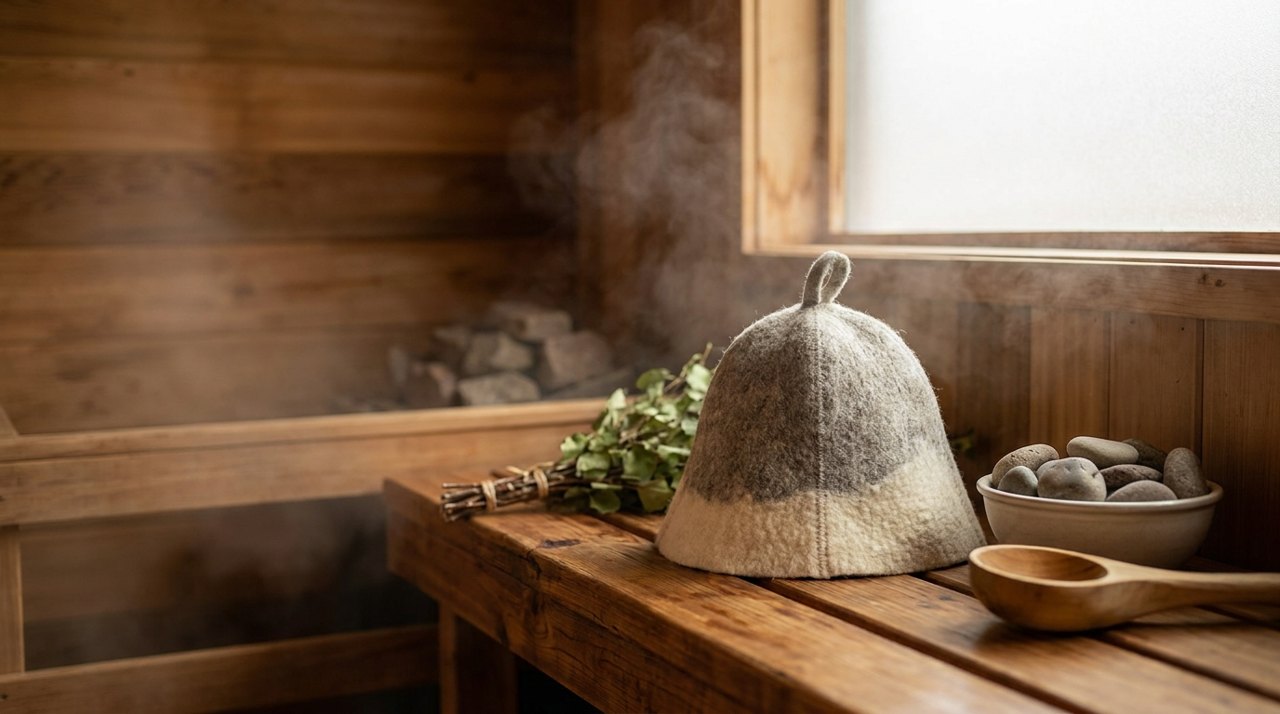
A hat labeled "100% wool" will rarely tell you the breed. What it can tell you is whether the felt is dense, firm and thick, which is the real test. The DIVELUX wool sauna hat is a good example of this crossbred style: a medium-coarse wool felt with enough body to stand on its own, in a natural grey that comes from mixing undyed fleeces rather than from a dye bath. See where natural wool hat colors come from for why that matters.
The Russian sauna hat descends directly from valenki, the seamless felt boots that kept peasants alive through winters at minus forty. Valenki were made by hand from coarse sheep wool, fulled with hot water and rolled until they could stand up on their own. Wool was judged by how well it felted, not how soft it was. When bathhouse culture spread felt caps to protect the head in the steam room, it pulled from the same fiber pool and the same makers. The result is a tradition that values thick, stiff, domed felt with a plain finish. Many of the cheapest and many of the best hats on the market today still come out of this lineage.
The Kazakh and Kyrgyz steppe produced felt for millennia before the Russian bathhouse existed. The Pazyryk burials in the Altai, dated around 400 BC, hold felt wall hangings, saddle covers and hats made from coarse steppe wool, still intact. The modern Kyrgyz kalpak, a tall white felt hat with black trim, is made from the same kind of fat-tailed sheep fleece. It is thin by sauna standards but stiff enough to keep its peaked shape for years. The Central Asian contribution to your sauna hat is the technique itself: layering, wetting, rolling and shrinking wool into a shaped object without a loom. The longer history is in Felt: Humanity's Oldest Fabric.
New Zealand is the largest exporter of crossbred wool on earth, and its Romney, Perendale and Corriedale clips built the global market for medium and coarse wool sold by micron. This is the fiber behind most machine-made felt, carpet, and increasingly the better commercial sauna hats. New Zealand also scours and grades to a consistency that the older traditions cannot match, which is why mills that want repeatable 30 micron felt tend to buy Kiwi fleece. The tradeoff is that this wool is more traceable and more expensive than an unnamed Eastern European lot, so it shows up in mid-priced and premium hats more than in bargain ones.
If you want to compare a few of these felt styles side by side, the DIVELUX sauna hats collection covers grey, white and two-tone crossbred felts in the same basic pattern, and the classic grey is also available on Amazon for anyone who wants to try one before going deeper into breed-specific hats.
The sheep behind your hat is rarely a pedigree animal. It is more often a working crossbred, raised for meat and shorn as an afterthought, whose wool happens to have exactly the scale structure and stiffness that felt has always needed. That is the honest origin story, and it is a better one than any label promising luxury fiber.
Handmade from 100% natural wool felt. 7 colors, classic and bucket styles, one size fits most. $19.99 with free US shipping and 30-day returns.
Shop DIVELUX sauna hats →