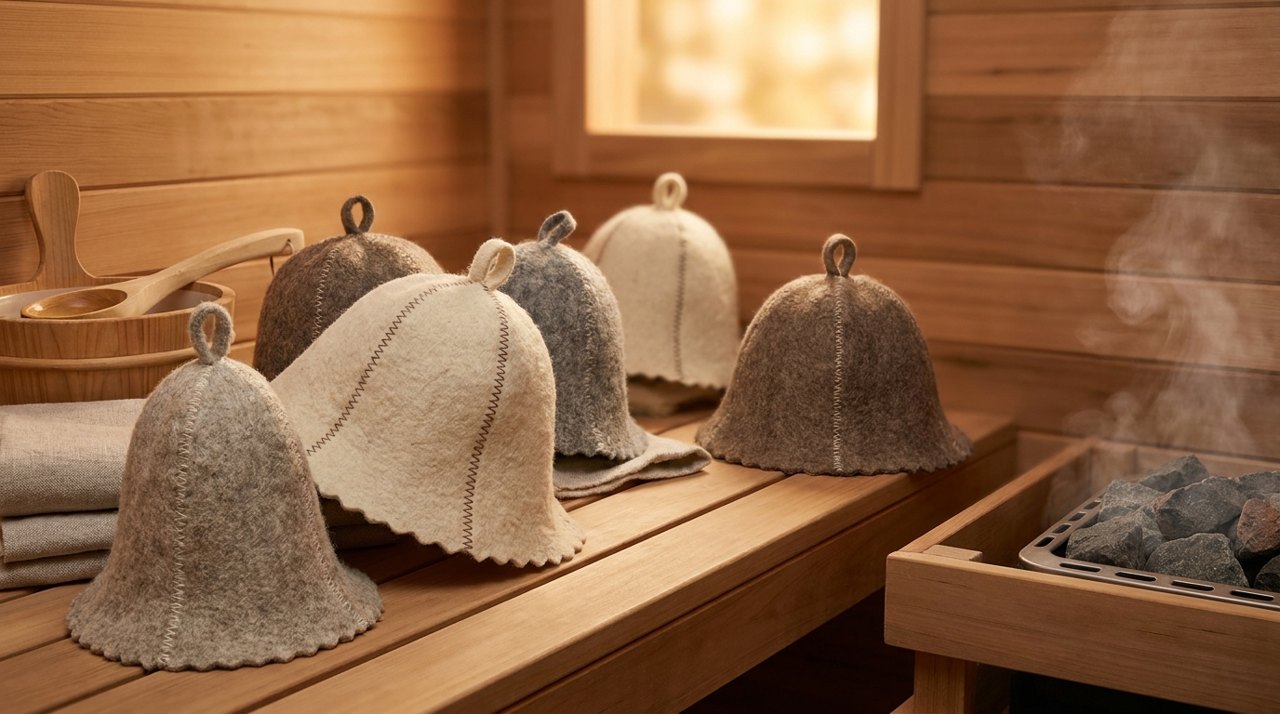
Scroll through any marketplace and you'll see two clusters of sauna hats: a pile at $7-9 and another at $15-30, with a thinner tier above $35. The gap isn't branding or greed. It's the price of wool, the cost of felting it by hand, and the arithmetic of what a retailer keeps after fees. Once you run those numbers, an $8 "wool" hat stops being a bargain and starts being a material claim that can't add up.
A finished felt sauna hat weighs somewhere between 100 and 160 grams depending on thickness and brim size. Wet felting doesn't waste much fiber, but a maker still starts with roughly 130-200 grams of carded wool to allow for trimming and the odd failed piece.
Raw greasy fleece from coarse breeds is cheap at the farm gate, often a couple of dollars per kilo. That's not what a hat maker buys, though. They buy wool that's been scoured, carded and sometimes pre-dyed into batts or roving ready for felting. In wholesale quantities that runs about $10-18 per kilo for coarse crossbred wool and $25-40 per kilo for merino. So the fiber in one hat lands at:
Small, but notice that the low end of that range is already close to half of what an $8 hat can spend on the entire product. And we haven't made anything yet.
This is where the two price clusters really split. There are two fundamentally different ways to turn material into a hat shape.
Wet felting a wool hat means laying out fiber in layers around a resist, wetting it with hot soapy water, rubbing and rolling it for 30-60 minutes until the scales on the fibers lock together, then fulling it, shaping it over a block and drying it for a day or more. Even in an efficient workshop, a single hat absorbs 40-90 minutes of skilled labor plus drying space. In Eastern Europe, where much of the world's sauna hat felting happens, that labor is cheap by Western standards but far from free. Call it $3-7 in wages per hat. If you're curious about the full process, our walkthrough from fleece to felt covers each stage.
Die-cutting synthetic felt is a different industry entirely. Needle-punched polyester or acrylic "craft felt" arrives on a roll at $1-2 per square meter. A press stamps out four panels in a second. A sewing machine joins them in under two minutes. Material for a hat costs perhaps $0.40, labor another $0.50. The panels don't shrink, don't need shaping and don't need drying racks. That's a $1 hat at the factory door, and it's why you'll notice cheap hats almost always have visible seams. Seamless shapes only come from felting.
Some cheap hats split the difference with "wool blend" felt, typically 20-30% wool needled into a polyester base. This still comes off a roll and gets die-cut. The wool content is enough to print the word on the tag and not enough to change how the hat behaves in a 90°C room.
Work backward from an $8 sticker on a big marketplace and the answer falls out quickly.
| Line item | $8 marketplace hat | $20 wool hat | $45 premium hat |
|---|---|---|---|
| Marketplace referral fee (15%) | $1.20 | $3.00 | $6.75 |
| Fulfillment and storage | $4.00-4.50 | $4.50-5.00 | $5.00-6.00 |
| Inbound freight and packaging | $0.50 | $1.00-1.50 | $2.00-3.00 |
| Left for the product itself | $1.80-2.30 | $10.50-11.50 | $29-32 |
| Cost of wool fiber alone | $1.50-3.50 | $1.50-3.50 | $4-8 |
| Felting labor | $3-7 | $3-7 | $5-10 |
Look at the first column. After marketplace fees and shipping, about two dollars remain to pay for material, labor, factory overhead, the importer's margin and the seller's profit. The wool fiber alone would eat that entire budget before anyone touched it. There's no clever sourcing that fixes this. A hat sold for $8 through a fee-charging marketplace is a die-cut synthetic or a low-percentage blend, whatever the listing says. The burn, smell and touch tests will confirm it in about a minute once it arrives.
The one honest exception: a felter selling directly at a craft market with no fees and no shipping can occasionally clear a real coarse-wool hat at $10-12. Online, that math doesn't survive.
The middle column is where a hand-felted, 100% wool hat becomes viable. Around ten to eleven dollars of product budget covers coarse or crossbred wool, a proper felting session, factory overhead and a modest margin for both maker and seller. Nobody is getting rich, but nobody is faking anything either.
The DIVELUX wool sauna hat at $19.99 is a useful reference point for this tier. It's a seamless wet-felted hat in undyed grey, sold both direct and on Amazon, and the price sits almost exactly where the cost structure says an honest wool hat should. Hats in this range typically share a few traits:
What you're paying for at $20 is the material and the felting. Nothing else. That's why two hats from different sellers in this tier often feel nearly identical in the hand: they may well come from the same handful of workshops.
Above $30 the wool cost barely changes. What changes is everything layered on top of it.
A $45 hat is often a genuinely better object than a $20 one, especially where thickness or fiber grade is the upgrade. But it's also often a $20 hat with a logo and a box. Reading the listing for millimeters and wool type tells you which one you're looking at.
Treat price as a material filter, not a quality ranking. Under about $12 online, assume synthetic or blend regardless of the tag. From $15 to $30, expect real wool and judge hats on thickness, finish and fit rather than price. Above that, ask what specifically the extra money bought. If the answer is embroidery you like, fair enough. If the answer is nothing you can name, the mid tier will serve you just as well in the hot room. Browsing a range like the DIVELUX sauna hats collection side by side makes the pattern obvious: same felt, same wool, and the price moves with the decoration.
The one thing money can't buy at $8 is wool. Everything above that is negotiable.
Handmade from 100% natural wool felt. 7 colors, classic and bucket styles, one size fits most. $19.99 with free US shipping and 30-day returns.
Shop DIVELUX sauna hats →