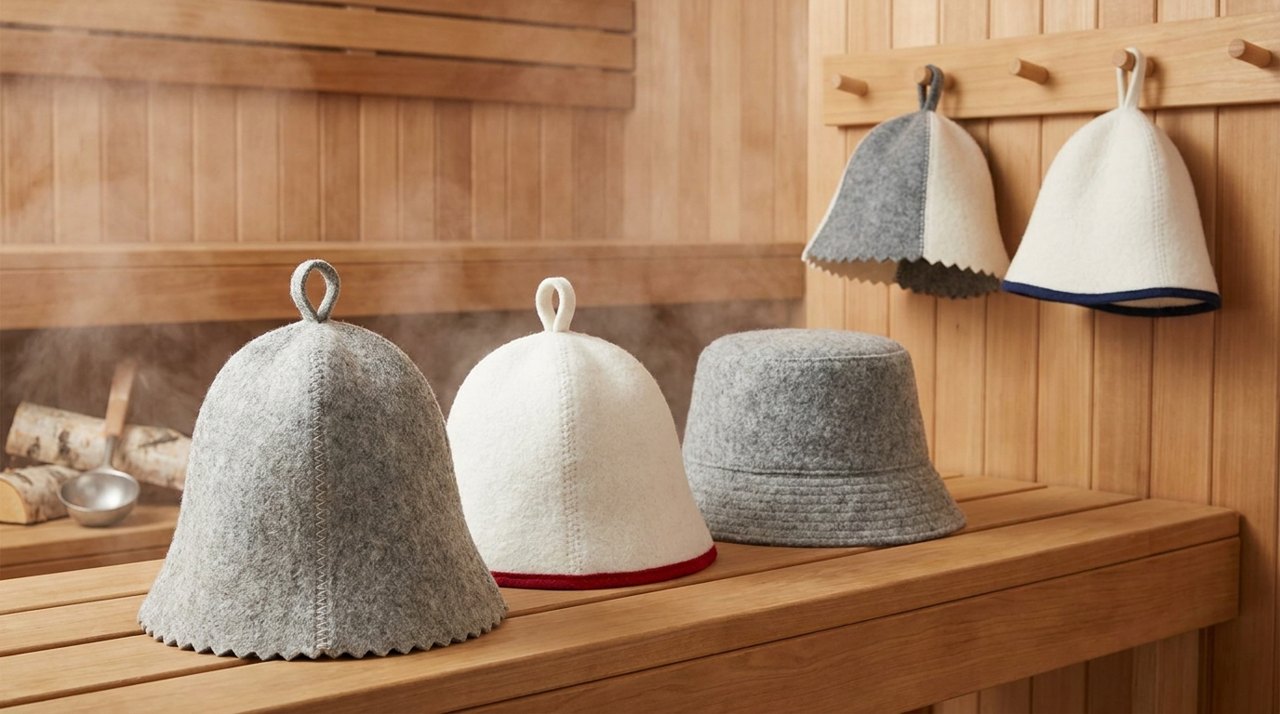
Read enough sauna hat listings and you start to notice how carefully some of them avoid one word: "wool". A hat can be called "felt", "felted", "wool-style", "wool blend" or just "sauna hat" with no material at all, and each of those phrasings means something different for how it behaves at 90°C. This is an audit of how brands and marketplace sellers actually label their hats, which ones state their fiber content plainly, and how to check a claim before you pay for it.
The four ways a listing describes material
After going through a few dozen product pages on brand sites, Amazon, Etsy and eBay, nearly every material claim falls into one of four buckets. The wording tells you a lot about what the seller is willing to stand behind.
| Label wording | What it usually means | Confidence |
|---|---|---|
| "100% natural wool" / "100% sheep wool felt" | Pure animal fiber, no synthetic binder. A specific, testable claim. | High |
| "Wool felt" | Wool is present, but the share is unstated. Can be 100%, can be 60/40 with polyester. | Medium |
| "Felt" / "felted fabric" / "thick felt" | Often needle-punched polyester or acrylic craft felt. Wool is not promised because it is not there. | Low |
| Material not listed | Seller either does not know or would rather you did not ask. Assume synthetic until proven otherwise. | Very low |
The key point is that "felt" is a construction, not a fiber. You can felt wool, and you can needle-punch polyester into something that looks and feels similar on a product photo. If you want the background on why that distinction matters in the hot room, felted versus knitted wool explains the structure, and the wool versus synthetic comparison covers what happens to each fiber under heat and sweat.
Brands that state their fiber content plainly
Two names come up repeatedly as examples of unambiguous labeling.
- DIVELUX. The product page for its thick felt classic states 100% natural sheep wool, and the same wording carries over to the listing on Amazon, which is worth noting because brands frequently soften their claims on marketplaces. The felt is around 3 to 4 mm, the hat is in the $20 range, and the natural colors across the DIVELUX store are undyed grey, white and brown fleece rather than pigment, which is one of the easier things to verify by eye.
- Halsa. Their listings also state 100% wool outright, with a felt weight noted, and the material line does not change between their own site and third-party sellers. Prices sit a little higher, but the label is the kind you can hold them to.
What both have in common is a claim that could be falsified. "100% natural wool" is a statement a chemist could check with a burn test in thirty seconds. "Premium felt" is not. A brand that gives you a percentage is exposing itself to being caught out, and that willingness is itself a signal.
Where the labeling gets slippery
The less honest patterns cluster on marketplaces, where listings are written by resellers who may never have handled the product. A few recurring habits:
- The word "wool" appears in the title but not in the specifications. The title reads "Wool Felt Sauna Hat", the material field lower down says "Felt" or "Polyester". The title is marketing, the spec field is the legal-ish bit. When they disagree, believe the spec field.
- "Wool blend" with no ratio. A blend can be 80% wool or 20% wool. Without the number the phrase means almost nothing, and a hat that is mostly acrylic will run hotter and hold sweat against your scalp differently. Our piece on what "100% natural wool" really means goes through why the percentage is the whole argument.
- Stock photos borrowed from a wool brand, product that is not. Several $8 listings use imagery that clearly belongs to a different, thicker hat. The giveaway is a listed thickness of 1 to 2 mm alongside photos of a hat that is visibly twice that.
- "Natural" without "wool". Rayon is technically derived from a natural source. So is the cotton in a cotton-polyester blend. "Natural fibers" is a phrase that has been stretched to cover a lot of things that are not sheep.
- Claims that move. A listing that says 100% wool in one variant and "felt" in another color of the same hat is telling you the colors are made differently, or that nobody checked.
None of this is illegal in most jurisdictions, and a lot of it is carelessness rather than deception. But the result is the same: you cannot tell from the page what you are buying.
Why the label actually matters in the hot room
A sauna hat works by insulating your head from the hottest air in the room and by managing sweat. Wool does both because its crimped fibers trap air and it can absorb a third of its weight in moisture before feeling wet. Polyester felt traps air reasonably well when new, but it does not absorb, so sweat pools at the brim and the hat starts to feel clammy within a session. Synthetic fiber also softens and can deform above roughly 100°C, which is a temperature the top bench of a Finnish sauna can hit. Wool chars rather than melts, a point covered in whether wool burns. The practical difference is that a real wool hat lasts several years of weekly use, while a thin synthetic one typically goes limp and flat within months.
A checklist for verifying a claim before you buy
You do not need lab equipment. You need about five minutes and a willingness to scroll past the photos.
- Find the material field, not the title. On Amazon that is "Material" under product details. On Etsy it is the "Materials" line. On brand sites it is usually the specifications tab. Note exactly what it says.
- Look for a percentage. "100% wool" or "100% sheep wool" is the target. "Wool felt" with no number is a question you should ask the seller directly.
- Check the thickness. Real felted wool sauna hats are typically 3 to 5 mm. A listed thickness of 1 to 2 mm, or none at all, suggests thin craft felt, whatever the fiber. Weight is a decent proxy: a genuine wool hat generally weighs 100 to 150 grams.
- Compare the price to the material. Raw wool felt at 3 mm costs real money. A hat at $6 to $8 shipped is very unlikely to be pure wool, no matter what the title says.
- Read the negative reviews, not the positive ones. Complaints about a "plastic smell", "melting", "pilling into balls" or the hat "flattening" are all synthetic tells. Complaints about a "sheep smell" are, ironically, the opposite. That lanolin scent is one of the more reliable signs of the real thing.
- Look for consistency across channels. If the brand site says 100% wool and the marketplace listing says "felt", email and ask which is correct. Honest brands answer quickly and specifically.
- Test it when it arrives. Pull a few fibers from an inside seam and hold a match to them. Wool smells like burnt hair and leaves a crumbly ash. Synthetic smells like plastic and leaves a hard bead. It takes ten seconds and settles the matter, and most marketplaces allow returns if the label was wrong.
What an honest label looks like
The best listings answer all of the questions above without being asked: fiber content with a percentage, felt thickness in millimeters, weight, and whether the color is natural or dyed. That last item matters more than people expect, because undyed fleece colors are easy to confirm and dyed ones raise their own questions about colorfastness in sweat. When a brand volunteers those four numbers, it is usually because they have nothing to hide. When a listing gives you a paragraph of adjectives and no numbers, the absence is the answer.