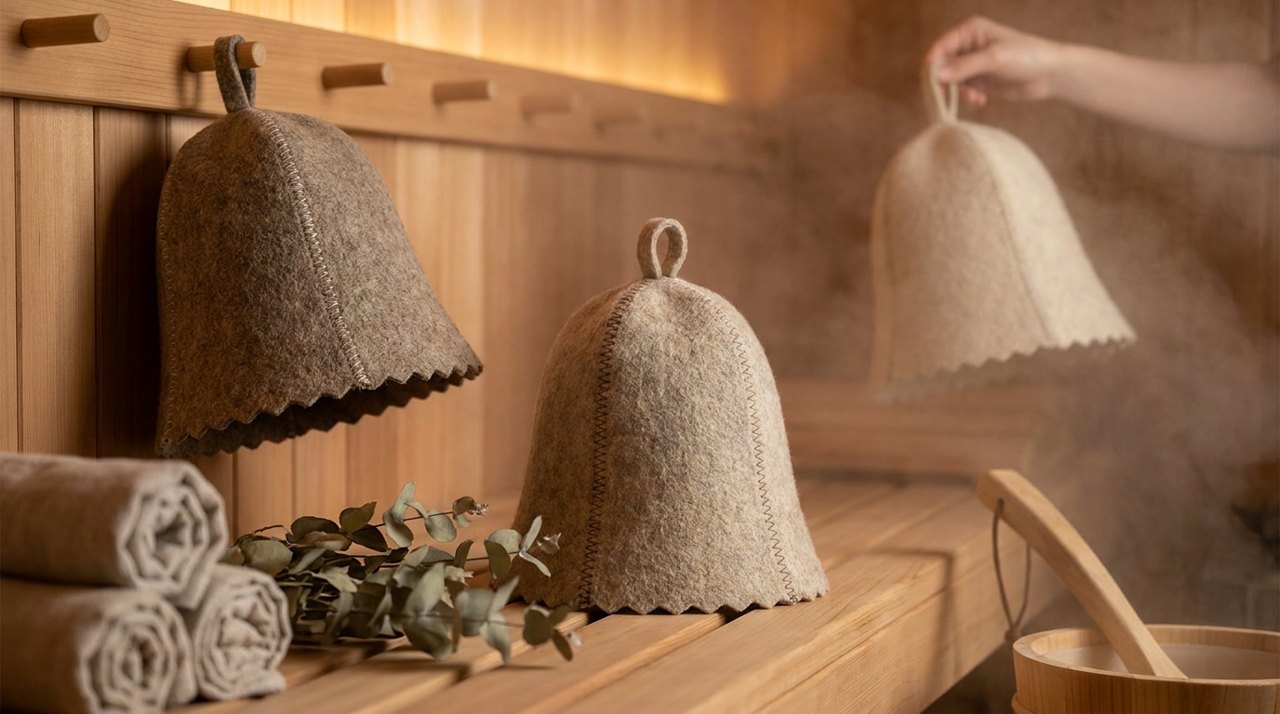
Recycled wool sounds like the obvious choice for anyone who cares where their kit comes from. It keeps fleece out of landfill, skips a whole round of shearing and scouring, and usually costs less. But a sauna hat is a strange product: it is a piece of insulation you put on your head in 80-100°C air, and its whole job depends on the felt holding together for years of soaking, squeezing and drying. Whether recycled wool is up to that depends on what actually happens to the fiber during recycling. This is an honest look at both sides.
Wool recycling is not new. Prato, in Tuscany, has been shredding old wool garments back into fiber since the 1800s, and the resulting "shoddy" and "mungo" were staples of cheap Victorian cloth. The process today is mechanically similar, just cleaner.
So far so good. The output is real wool, with the same scales, the same crimp, the same lanolin-stripped protein structure. The problem is length.
Felt has no yarn and no weave. It is held together purely by fibers entangling and their scales ratcheting against each other. The strength of that entanglement scales with how many times each fiber crosses another, and that is a direct function of fiber length.
A fresh coarse wool staple used for sauna felt runs roughly 70-120 mm. Garnetting tears that fiber. It does not cut it cleanly; it rips it at weak points, and a typical reclaimed fiber ends up at 20-40 mm, with a long tail of fragments under 10 mm that are essentially dust. A 30 mm fiber crosses maybe a third as many neighbors as a 90 mm one. Fewer crossings means fewer lock points, which means the felt pulls apart more easily, pills faster and sheds fiber at the edges.
The felt maker can compensate a little by fulling harder and longer, which densifies the sheet, but there is a ceiling. Past a point, extra fulling just makes a stiff, brittle board that cracks at the fold rather than a supple hat. If you want the physics of why density and thickness matter separately, see felt density vs thickness.
Recycled fiber has a second, quieter problem: it has already been through one life. Every wash cycle and every year of UV exposure degrades keratin a little, so the scales are less pronounced and the fiber is less elastic. It felts, but it felts lazily.
Because short reclaimed fiber felts poorly on its own, most commercial recycled wool felt is a blend. The common recipes look like this:
| Blend | Typical use | What the synthetic does | Sauna suitability |
|---|---|---|---|
| 70% recycled wool / 30% polyester | Craft felt, placemats | Long PET fibers act as a scaffold the wool clings to | Poor: PET softens and traps heat, no breathability |
| 50% recycled wool / 50% virgin wool | Blankets, some hats | Virgin staple supplies the length | Acceptable if the virgin share is genuinely coarse, long fiber |
| Recycled wool + acrylic + latex backing | Underlay, car insulation | Latex glues the web together | Not suitable: latex outgasses and cracks in dry heat |
| Needle-punched recycled wool with low-melt polyester | Insoles, industrial padding | Bicomponent fibers melt at 110-130°C to bond the sheet | Not suitable: bonding temperature overlaps sauna ceiling temperatures |
That last row deserves emphasis. Some needle-felted recycled wool uses "low-melt" bicomponent polyester that is deliberately fused in an oven. A hat made from it will soften and go misshapen on the top bench of a properly hot Finnish sauna, and the smell is unpleasant. The broader argument against plastic in the hot room is in wool vs synthetic sauna hats, and it applies doubly here because the synthetic is hidden inside a product sold as wool.
None of this makes recycled wool a bad material. It is an excellent material for jobs where the felt lies flat, stays dry-ish, and is not asked to survive repeated wet handling.
If a recycled mat outlasts a few years of use and then gets recycled again, that is a real environmental win, and it is where the material should go.
A sauna hat gets wrung out, dunked in cold water, stretched over a head, and dried, over and over. The seams and the brim edge are where felt fails first, and those are exactly the places where short fibers let go. A hat made from good virgin coarse wool, fulled to 3-5 mm, routinely lasts five or more years of weekly use. I have not seen a majority-recycled felt hat make it past two without going fuzzy and thin at the crown.
There is also a thermal argument. The insulating value of felt comes from air trapped between crimped fibers. Reclaimed fiber has lost some of its crimp, so a recycled sheet of the same thickness traps slightly less air and does slightly less to keep your head cool. Not a huge difference, but measurable.
This is why the hats worth buying, including the DIVELUX wool sauna hat, are made from virgin fleece rather than reclaimed stock. The undyed grey is simply the natural color of mixed fleece, which also means no dye lot needs to be matched across batches. If you are comparing shapes and thicknesses, the DIVELUX sauna hats collection lists the options side by side, and the classic grey is also available on Amazon.
Is virgin wool the less sustainable choice, then? Not obviously. A hat that lasts eight years and is then compostable has a smaller footprint than three recycled-blend hats that end up in the bin because the polyester content makes them unrecyclable. The fuller accounting is in is wool sustainable?
Labeling rules for recycled content are loose in most markets, so treat the words with some care.
When in doubt, the physical tests hold up: a burn test, a smell test and a simple tug at the edge tell you a lot. I walk through them in how to tell real wool felt from fake. Pull a few fibers from a hidden edge. If they are short, dull and mixed with something slick that does not crimp, you are holding a recycled blend, whatever the tag says.
Recycled wool felt is a good material in the wrong place when it is made into a sauna hat. The shredding step that makes recycling possible is the same step that removes the fiber length pure felt depends on, and the binders used to compensate are the very plastics you want to keep out of the hot room. Buy recycled wool for your sauna bench mat, your boot liners and your workshop. For the hat, buy virgin wool once and look after it well.
Handmade from 100% natural wool felt. 7 colors, classic and bucket styles, one size fits most. $19.99 with free US shipping and 30-day returns.
Shop DIVELUX sauna hats →