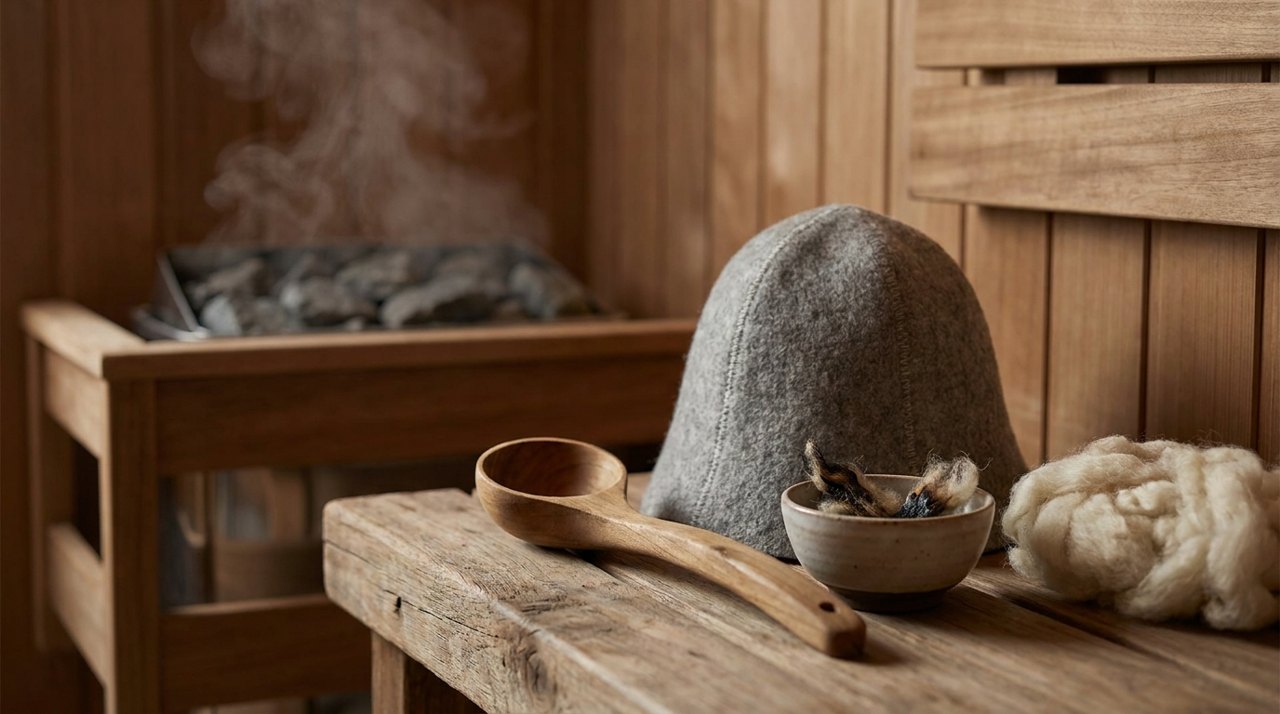
A sauna hat only does its job if it is actually wool felt. Acrylic and polyester "felt" looks close enough in a product photo, but it insulates poorly, holds sweat like a sponge, and can soften or scorch near a hot stove. The good news: wool is one of the easiest fibers to identify without a lab. Your fingers, your nose and a single plucked fiber over a candle will tell you the truth in under five minutes. Here is how to run each test, what to look for, and how to read a label before you buy.
Real wool felt is made by matting sheep fibers together with heat, moisture and friction. It is slow and the raw material is not cheap. Synthetic "felt" is needle-punched polyester or acrylic, produced by the roll for pennies. Some sellers call it "wool felt," "wool blend" or simply "felt" and let you assume the rest. Others use a genuine wool blend with 20 to 30 percent wool and market it as natural. If you want the background on why the material matters so much in the hot room, read Wool vs Synthetic Sauna Hats: The Material Truth. This article is about catching the difference in hand.
Pick the hat up and squeeze the crown. Then rub the surface with a dry fingertip. Wool felt and synthetic felt feel different in four specific ways.
| Property | Real wool felt | Synthetic felt |
|---|---|---|
| Surface | Matte, slightly fuzzy, uneven fiber ends | Faint sheen, uniform, sometimes slippery |
| Density | Dense and heavy for its size, usually 3 to 5 mm thick | Lighter, often thin, feels papery when bent |
| Spring | Compress it and it slowly recovers its shape | Either stays creased or snaps back instantly like foam |
| Warmth | Warms quickly in your palm and holds it | Feels cool and stays cool |
| Friction | Fingertip drags slightly, small grip | Fingertip glides |
The spring test is the most reliable of these. Crimped wool fibers act like millions of tiny coils, so a good felt pushes back gently and recovers over a second or two. Polyester fibers are straight, so the felt either creases permanently or behaves like a kitchen sponge. If you want to understand why that crimp also makes wool insulate, Why Wool Insulates covers the physics.
One caution: very fine merino felt can feel smoother than coarse wool, and cheap wool can be surprisingly thin. Touch narrows the field. The next two tests settle it.
Hold the hat close to your face and breathe in. New wool felt has a faint, earthy, slightly greasy smell from residual lanolin, the natural wax in fleece. Some people describe it as barn or wet dog, especially on undyed grey and brown wool. It is mild and fades over the first few sessions. Synthetic felt smells of nothing at all, or of plastic packaging and factory chemicals.
Heat makes this test far stronger. Wear the hat through one sauna session, or hold it near a hot cup of tea for a minute. Warm wool smells unmistakably animal. Warm acrylic smells sharp and chemical, a bit like a hot hair dryer. If your new hat smells like a sheep, that is a good sign, and this article on lanolin smell explains why you should not try to wash it out.
Wet wool also has a distinct smell that synthetic fibers simply cannot fake. Dampen a corner with warm water and sniff. Wool gives that classic wet-sweater note. Polyester stays odorless.
This is the definitive test, and you do not need to damage the hat. Every felt hat has loose fibers on the surface or at a seam. Pluck two or three with tweezers, twist them together, and hold them with the tweezers over a candle or lighter in a sink. Never burn the hat itself, and do this outdoors or over a ceramic plate.
A blend shows both behaviors: the fiber chars and smells of hair, but a small hard bead forms at the tip. That tells you the "wool" is cut with polyester. The self-extinguishing behavior is also the reason wool is the only sensible fiber to wear a foot from a stove, which Does Wool Burn? goes into in detail.
A label can confirm what your tests found, or reveal what the seller hoped you would not notice. Watch for these.
Even "100% wool" leaves room for interpretation on fiber grade and thickness, which What '100% Natural Wool' Really Means unpacks.
If you are buying online and cannot touch the hat, a few direct questions separate makers from resellers.
A maker answers all five without hesitation. A drop-shipper answers with adjectives. For reference, the DIVELUX wool sauna hat lists 100 percent wool felt and a stated thickness, which is the kind of specificity you want to see, and it is also available on Amazon if you prefer that return policy. The DIVELUX sauna hats collection is worth a look for the other natural shades. Whatever brand you choose, run the touch and smell tests the day it arrives, while a return is still easy.
| Test | Says wool | Says fake |
|---|---|---|
| Squeeze | Slow, springy recovery | Creases or bounces like foam |
| Rub | Matte, slight drag | Sheen, slippery |
| Sniff cold | Faint lanolin, earthy | Nothing or plastic |
| Sniff warm or wet | Wet sweater, animal | Hot plastic |
| Burn a plucked fiber | Chars, self-extinguishes, hair smell, crumbly ash | Melts, keeps burning, plastic smell, hard bead |
| Label | Fiber percentage stated | "Felt," "wool-like," no numbers |
Two of the three physical tests pointing the same way is enough to trust. If the burn test disagrees with the label, trust the burn test. Wool does not lie, and neither does a melted bead of polyester.
Handmade from 100% natural wool felt. 7 colors, classic and bucket styles, one size fits most. $19.99 with free US shipping and 30-day returns.
Shop DIVELUX sauna hats →