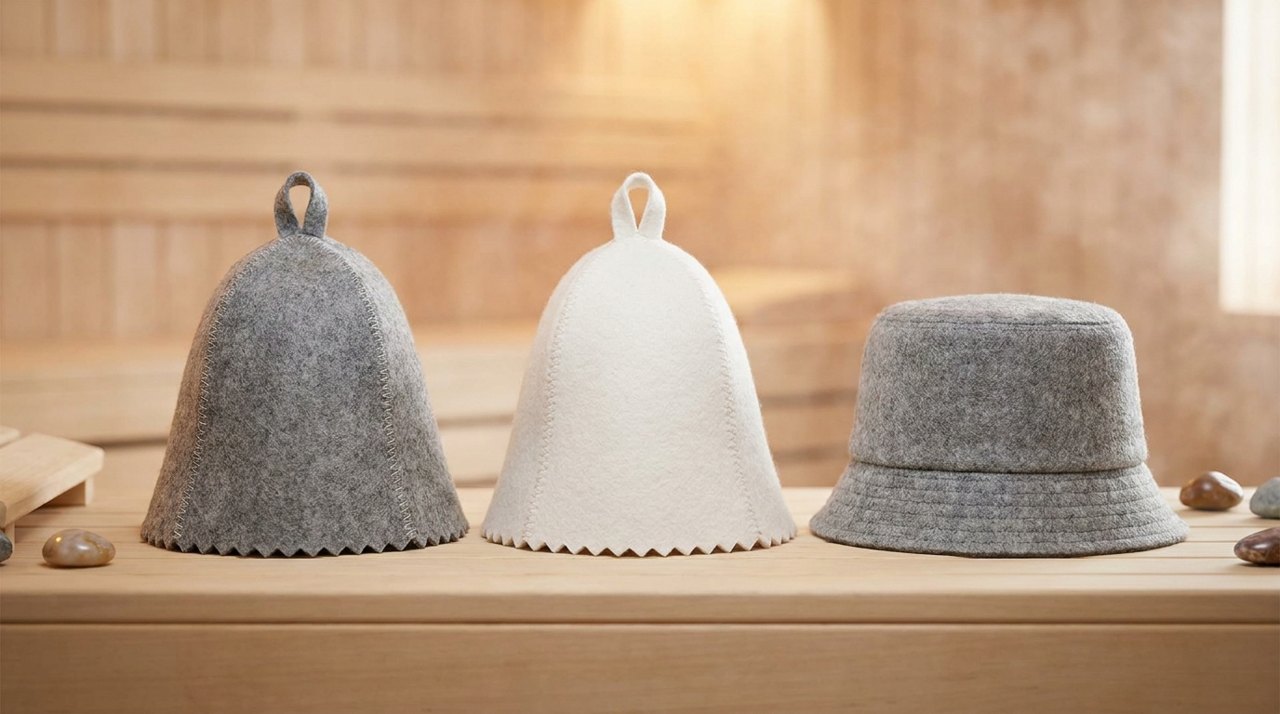
Most sauna hat listings use three words as if they meant the same kind of thing: wool, felt and linen. They don't. Wool and linen are fibres. Felt is a way of building fabric. Once you separate those two ideas, the choice gets much simpler, and you can tell which cheap "felt" hats to skip.
Felt is a construction, not a fibre
Felt is made by matting fibres together instead of weaving or knitting them. Real wool felt depends on what wool fibres do naturally. Each fibre is covered in tiny scales, and with moisture, heat and friction those scales lock into each other. The result is a dense, springy sheet with no grain and no threads to unravel. Because there is no weave, the fabric holds a lot of still air, and still air is what insulates your head from the heat at the top of the room.
Polyester has no scales, so it can't felt the same way. "Polyester felt" is usually made by needle-punching synthetic fibres into a mat or bonding them with heat or adhesive. It looks like felt in a product photo, but it acts differently in the heat. So "felt sauna hat" alone tells you nothing about the fibre. You need the fibre named on the label: 100% wool felt or something else.
Linen is a different thing again. It's woven from flax, a plant fibre, into a thin fabric. A linen sauna hat is usually a sewn bucket or cap, sometimes lined, and much lighter than a felt hat.
Polyester felt: what goes wrong
Polyester felt is popular because it's cheap to make in bulk and easy to cut into neat shapes. It also has some real drawbacks:
- Thin and flat. Most synthetic felt hats are a few millimetres thick at most and fairly compressed. They hold less insulating air than a good wool felt of the same thickness.
- It doesn't handle sweat well. Wool can absorb a lot of moisture into the fibre and still feel dry on the surface. Polyester barely absorbs any, so sweat sits on the surface or runs down your forehead.
- Odour builds up. Synthetic fibres hold on to body odour, and after a few months of regular use many cheap hats smell even after washing.
- Misleading labels. "Wool feel", "wool blend" or just "felt" usually means mostly synthetic. Our guide on how to tell real wool felt from fake covers the burn, smell and touch tests.
A polyester felt hat won't melt at normal sauna temperatures, and it's better than a bare head in a very hot room. But it's the weakest of the three for the job.
Linen: the lightweight alternative
Linen has fans for good reasons. It feels cool and dry against the skin, it's light enough to forget you're wearing it, and a simple sewn linen hat is cheaper to produce than a thick hand-felted one. Many people who prefer moderate saunas like it, and so do people who find any wool too warm or scratchy.
The trade-off is insulation. A woven layer of linen is thin and holds far less air than 4–5 mm of wool felt. In a dry Finnish sauna at 190°F, linen will soften the heat on your scalp, but it won't shield you the way thick felt does. Linen also crumples. It creases after every session and after every wash, and it loses its shape unless it's lined or stiffened. Some people like that lived-in look and some don't.
For a deeper comparison of the two natural fibres, including moisture handling, softness and how each one ages, see Wool vs Linen Sauna Hats: Two Natural Fibers, Two Different Jobs.
The comparison at a glance
| Wool felt | Polyester felt | Linen | |
|---|---|---|---|
| Insulation | High: thick, springy, traps air | Low to moderate: thin, compressed | Low: single woven layer |
| Feel at 190°F | Head stays noticeably cooler; brim shades ears and neck | Takes the edge off; sweat collects on the surface | Light and airy, but you still feel the heat |
| Care | Hand wash in cool water, air dry, reshape | Easy to wash; odour tends to stay | Follow the label; creases after every wash |
| Typical price | About $15–30 | About $8–15 | About $15–35 |
| Lifespan | Years, with gentle care | Often a season or two before it pills or smells | Several years; the shape softens over time |
| Who it suits | Regular users of hot, traditional saunas | Occasional use on a tight budget | Moderate heat, light-hat lovers, people avoiding wool |
A note on how to wear any of them
Whatever you choose, wear the hat dry. Dry felt and dry fabric hold air, and that air insulates your head from the hot layer near the ceiling. Wash the hat after your sessions, not before. For wool, that means by hand in cool, room-temperature water (about 20–24 °C / 68–75 °F). Squeeze it gently, reshape it and let it air-dry. Never use a washing machine or a dryer, and never use warm or hot water.
A good wool felt hat is cut a little roomy on purpose. That leaves space for air and fits larger heads. If it sits low at first, fold the brim up slightly. Don't try to shrink it.
Which one should you buy?
For most people using a traditional hot sauna, the answer is wool felt. It insulates best, handles sweat best and lasts the longest, and a well-made one costs only a little more than a synthetic copy. Choose linen if your sessions are moderate, you prefer something you barely feel, or you want to avoid wool altogether. Skip polyester felt unless price is the only thing that matters.
When you shop for wool felt, look for three things: a label that says 100% wool, real thickness (around 4–5 mm is a good benchmark), and a shape with a brim that covers your ears. DIVELUX's handmade wool felt hat is one widely available example. It's 100% wool felt about 4–5 mm thick and comes in classic bell and bucket shapes for $21.99. It's one size for heads up to 24 in / 61 cm and settles to your head after a few sessions. You can see all seven colours, from undyed white and grey to versions with dyed trims, with free US shipping, 30-day returns and 15% off when you buy three or more hats. It's also sold on Amazon, where it's the #1 Best Seller in Sauna Accessories.
Other good wool felt makers exist, especially small Finnish, Estonian and Russian felting workshops, and many of them make excellent hats. The material checklist matters more than the brand name.
FAQ
Is a "felt" sauna hat always made of wool?
No. Felt describes how the fabric is made, not what it's made of. Many cheap felt hats are polyester, so check the label for "100% wool".
Is linen cooler than wool in the sauna?
Linen feels cooler against your skin, but it insulates less. In a very hot sauna, thick wool felt usually keeps your scalp more comfortable, because it holds more air between your head and the heat.
Will a wool felt hat be too warm?
Not in the sauna. Its job is to slow heat getting to your head, not to keep you warm like a winter beanie.
How long does each type last?
A wool felt hat washed by hand in cool water and air-dried can last for years. Linen also lasts well but loses its shape. Polyester felt often starts to pill or hold odour within a season or two of regular use.